 Coaching Centre
Impulse and car safety
Impulse as FΔt = Δp, impulse as the area under a force–time graph, average and peak forces in collisions, extending collision time in sport and safety equipment, and evaluating crumple zones, seatbelts and airbags.
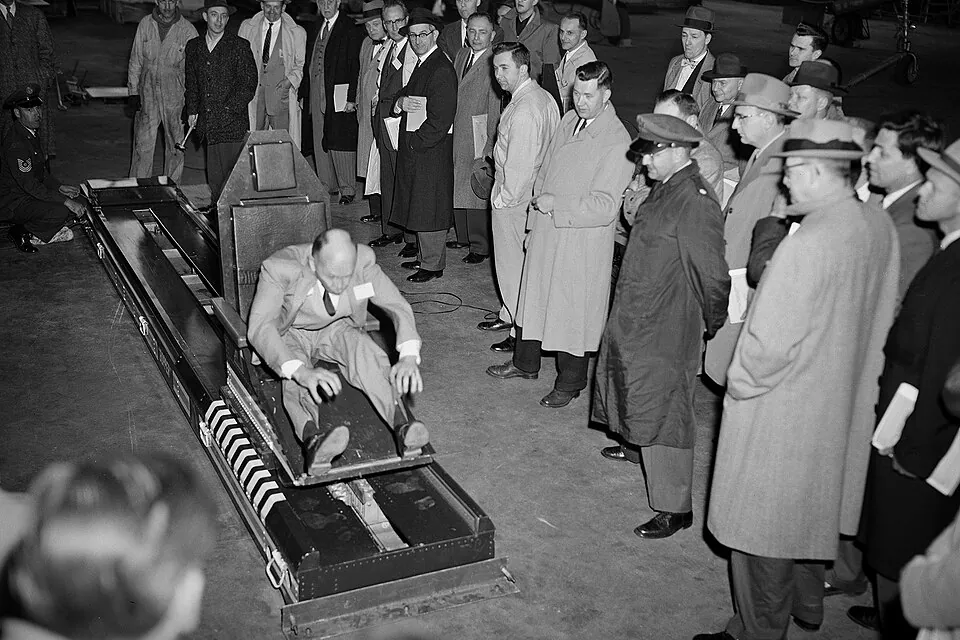
In 1954, US Air Force doctor John Stapp rode a rocket sled to 1,017 km/h and stopped in about 1.4 seconds, experiencing over 40 g. He survived with bruises and burst blood vessels in his eyes, and his data showed that people can survive enormous decelerations if they are well restrained. He spent the rest of his career campaigning for seatbelts in ordinary cars.
Every collision changes momentum. The question that decides whether something breaks, or someone is injured, is how quickly that change happens. Spread the same change of momentum over a longer time and the force drops. That one idea explains bent knees on landing, cricket gloves, crumple zones and airbags.
Impulse
Rearranging Newton's second law in its momentum form, $\vec F_{net} = \dfrac{\Delta\vec p}{\Delta t}$, gives
$$\vec F_{net}\,\Delta t = \Delta\vec p = m\vec v - m\vec u$$The product $\vec F\Delta t$ is called the impulse. It is a vector with units N s (the same as kg m s⁻¹), and it equals the change in momentum. For a given change in momentum, a longer collision time means a smaller average force:
$$F_{avg} = \frac{\Delta p}{\Delta t}$$A 0.40 kg ball hits a concrete floor at 10 m s⁻¹ and rebounds at 8.0 m s⁻¹. Contact lasts 2.0 ms. Find the impulse and the average force on the ball.
Force–time graphs
In a real collision the force isn't constant. It rises from zero as the objects deform, peaks, then falls back to zero as they separate. The impulse is the area under the force–time graph, and the average force is the height of a rectangle with the same area over the same time.
A force–time graph for a tennis racquet hitting a 0.058 kg ball is roughly a triangle with a peak of 650 N and a base of 4.0 ms. The ball arrives at 20 m s⁻¹. Find the impulse and the ball's speed as it leaves, travelling back the way it came.
Impulse in sport
- Catching: a fielder draws the hands back with the ball, stretching the stopping time and reducing the force on the hands.
- Landing: bending your knees after a jump stretches the stopping time from a few milliseconds to a tenth of a second or more.
- Follow-through: in golf, tennis and cricket, keeping the club or bat in contact for longer increases $F\Delta t$, so the ball leaves with more momentum.
- Padding: gym mats, helmets and shin guards all deform to make the stop last longer.
Car safety
In a crash, the car and everyone in it must lose all their momentum. The safety question is how to make that happen over as long a time as possible, with the force spread over as much of the body as possible.
| Feature | How it reduces injury |
|---|---|
| Crumple zone | The front (and rear) of the car is designed to fold up progressively, so the car takes longer to stop. This lowers the average force on the car and its occupants, and the work done crushing the metal absorbs kinetic energy. |
| Rigid passenger cell | A strong cage around the occupants keeps its shape, so the crumple zone doesn't intrude into the space people need. |
| Seatbelt | Stops the occupant with the car rather than hitting the dashboard or windscreen a moment later. The webbing stretches slightly, extending the stopping time, and spreads the force across the strong bones of the pelvis and chest. Pretensioners pull it tight at the moment of impact; load limiters let out a little webbing if the force gets too high. |
| Airbag | Inflates in about 30 ms and then vents as the occupant presses into it, extending the stopping time for the head and chest and spreading the force over a larger area, which reduces pressure. |
| Headrest | Limits how far the head snaps back in a rear-end collision, reducing whiplash. |
None of these ideas is especially new. Béla Barényi patented the crumple zone for Mercedes-Benz in 1952 and it reached production cars in 1959, the same year Volvo introduced the three-point seatbelt. Airbags were first sold in the early 1970s and became common from the late 1980s. Victoria was the first place in the world to make wearing seatbelts compulsory, in 1970, and road deaths there fell sharply.
A 70 kg occupant is in a car that hits a solid barrier at 50 km/h. Compare the average force on the occupant if they (a) hit the dashboard and stop in 10 ms, (b) are stopped by a seatbelt and airbag in 120 ms.
In Australia and New Zealand, the Australasian New Car Assessment Program (ANCAP) crash-tests new models and rates them out of five stars. Instrumented crash-test dummies record the forces and accelerations on the head, neck, chest and legs, and those numbers decide the rating. The ratings now also score how well a car protects pedestrians and cyclists, and how well its automatic emergency braking avoids crashes in the first place.
- A 0.40 kg ball at 10 m/s onto Thick foam (no bounce, 40 ms): the impulse is 4.00 N s, the average force 100 N and the peak 157 N.
- Switch to Concrete: it bounces back at 8.0 m/s, so the impulse rises to 7.20 N s, and over just 2 ms the average force is 3,600 N.
- Try Crash mat: the same 4.00 N s as foam, but stretched over 100 ms, so only 40 N.
- In Car occupant in a crash at 50 km/h, every option removes 972 N s. Hitting the dash gives about 142 g; seatbelt and airbag bring it down to about 12 g.
Test yourself
A 0.145 kg baseball moving at 40 m s⁻¹ is caught and stopped in 0.020 s. The average force on the glove is
$F = \dfrac{0.145 \times 40}{0.020} = 290$ N.
The area under a force–time graph for a collision represents
Area $= F\Delta t$ = impulse = change in momentum.
An egg dropped onto a pillow doesn't break, but the same egg dropped from the same height onto a tiled floor does. Compared with the tiles, the pillow
The change in momentum is the same; the longer stopping time gives a smaller force.
A force–time graph for a kick is a triangle with a peak of 1200 N lasting 8.0 ms. The impulse on the ball is
Area of a triangle: $\tfrac12 \times 1200 \times 0.0080 = 4.8$ N s.
Label the safety features of the car.
How does each safety feature mainly reduce injury?
Impulse is the product of force and , and it equals the change in . On a force–time graph, the impulse is the under the curve. An airbag increases the time taken to stop, which reduces the average on the occupant. A ball that bounces has a change in momentum than one that stops dead.
Evaluate the effectiveness of crumple zones, seatbelts and airbags in reducing injuries to car occupants in a frontal collision. Include a calculation in your answer.
All three features are highly effective, and most effective together, because each one increases the time over which an occupant's momentum changes.
In a crash, an occupant's change in momentum is fixed by their mass and speed. From $F\Delta t = \Delta p$, the average force is $F = \Delta p/\Delta t$, so a longer stop means a smaller force. For a 70 kg occupant at 50 km/h (13.9 m s⁻¹), $\Delta p = 972$ N s. Stopping against a rigid dashboard in about 10 ms gives $F \approx 9.7 \times 10^4$ N (about 140 g); stopping with a belt and airbag over about 120 ms gives $F \approx 8.1 \times 10^3$ N (about 12 g).
Crumple zones fold progressively, extending the time the whole car takes to stop and absorbing kinetic energy as work done deforming metal. Seatbelts make the occupant decelerate with the car rather than keep moving and hit the interior; their slight stretch adds time, and the wide webbing spreads the force over the pelvis and ribcage. Airbags cushion the head and chest, extending the stopping time further and spreading the force over a large area, which reduces pressure on any one part of the body.
The features depend on each other. A crumple zone only helps an occupant who is tied to the car by a seatbelt, and airbags are designed for belted occupants: an unbelted person can strike the bag while it is still inflating, at high speed. Airbags can injure small children or people sitting too close, which is why children should not sit in front of an active airbag. Crumple zones also work only once and give less protection in side impacts, where there is little room to crumple. Even so, the combination has greatly reduced deaths and serious injuries in frontal crashes, so it is very effective.