 Coaching Centre
Coulomb’s law
The inverse square law for the force between point charges, k and the permittivity of free space, Newton's third law for charges, adding forces from several charges in one and two dimensions, the field of a point charge, and why electric forces dwarf gravity for charged particles.
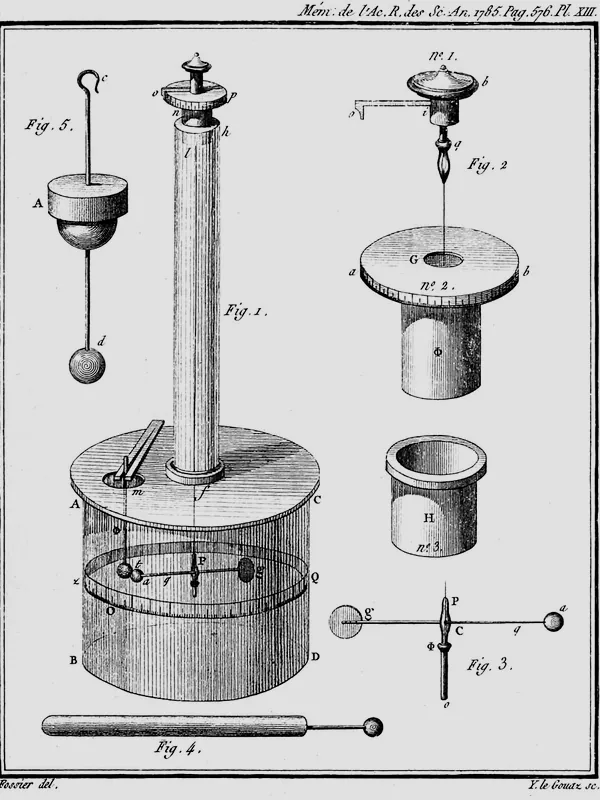
In 1785 Charles-Augustin de Coulomb hung a light needle from a silver wire thinner than a hair, put a small charged ball on one end and brought a second charged ball near. The force between the balls twisted the wire by a few degrees, and from the twist he measured forces of a few millionths of a newton. Halving the distance between the balls made the twist four times bigger. That single pattern holds from the electrons in an atom to the charge in a thundercloud.
The inverse square law
The size of the electric force between two point charges q1 and q2, a distance r apart, is
$$F = \frac{1}{4\pi\varepsilon_0}\,\frac{q_1 q_2}{r^2} = \frac{k\,q_1 q_2}{r^2}$$
where $\varepsilon_0 = 8.854 \times 10^{-12}$ C2 N−1 m−2 is the permittivity of free space (from the data sheet) and $k = \dfrac{1}{4\pi\varepsilon_0} = 8.99 \times 10^{9}$ N m2 C−2. Charges go in coulombs and r in metres, measured centre to centre. In air the force is almost the same as in a vacuum.
- F is proportional to the product of the charges: double one charge and the force doubles.
- F is inversely proportional to r2: double the distance and the force drops to a quarter.
- If $q_1 q_2$ is positive (like charges) the force is repulsive; if it is negative (unlike charges) it is attractive. Many students use magnitudes in the formula and decide the direction separately, which is safer.
- The two charges exert equal and opposite forces on each other (Newton's third law), even if one charge is much bigger than the other.
A +2.0 μC charge and a −3.0 μC charge are 0.30 m apart. Find the force each exerts on the other.
$F = \dfrac{kq_1q_2}{r^2} = \dfrac{(8.99 \times 10^{9})(2.0 \times 10^{-6})(3.0 \times 10^{-6})}{(0.30)^2} = 0.60$ N.
Unlike charges, so the force is attractive: each charge is pulled towards the other with 0.60 N.
Two charges repel with a force F. Both charges are doubled and their separation is tripled. What is the new force?
$F' = \dfrac{k(2q_1)(2q_2)}{(3r)^2} = \dfrac{4}{9}\,\dfrac{kq_1q_2}{r^2} = \dfrac{4}{9}F \approx 0.44F$.
The field of a point charge
Put a small test charge q0 a distance r from a charge q. Coulomb's law gives the force on it, and dividing by q0 gives the field (from 4B, E = F/q):
$$E = \frac{F}{q_0} = \frac{1}{4\pi\varepsilon_0}\,\frac{q}{r^2}$$
The field depends only on the source charge and the distance, not on the test charge. It points radially away from a positive charge and towards a negative one, and like the force it falls with the inverse square of distance.
Forces from several charges
Each pair of charges interacts as if the others weren't there. To find the net force on one charge, find the force from each of the others with Coulomb's law, give each a direction, and add them as vectors. This is the principle of superposition.
A (+2.0 μC), B (−3.0 μC) and C (+4.0 μC) lie on a straight line. B is 0.20 m to the right of A and C is 0.30 m to the right of B. Find the net force on B.
$F_{AB} = \dfrac{(8.99 \times 10^{9})(2.0 \times 10^{-6})(3.0 \times 10^{-6})}{(0.20)^2} = 1.35$ N, attractive, so to the left (towards A).
$F_{CB} = \dfrac{(8.99 \times 10^{9})(4.0 \times 10^{-6})(3.0 \times 10^{-6})}{(0.30)^2} = 1.20$ N, attractive, so to the right (towards C).
Taking right as positive: $F_{net} = +1.20 - 1.35 = -0.15$ N. The net force on B is 0.15 N to the left, towards A.
A +1.0 μC charge sits at a corner. A +2.0 μC charge is 0.10 m to its east and a −2.0 μC charge is 0.10 m to its north. Find the net force on the +1.0 μC charge.
Both have the same size: $F = \dfrac{(8.99 \times 10^{9})(1.0 \times 10^{-6})(2.0 \times 10^{-6})}{(0.10)^2} = 1.80$ N. The +2.0 μC charge repels it to the west; the −2.0 μC charge attracts it to the north.
$F_{net} = \sqrt{1.80^2 + 1.80^2} = 2.5$ N, at $\tan^{-1}(1.80/1.80) = 45°$, so the direction is N 45° W (north-west).
Electric force versus gravity
Coulomb's law and Newton's law of gravitation, $F = Gm_1m_2/r^2$, have the same inverse square form. The difference is in the constants and in the fact that mass has only one sign. For an electron and a proton in a hydrogen atom (r = 5.29 × 10⁻¹¹ m), the electric force is about 8.2 × 10⁻⁸ N, while gravity is about 3.6 × 10−47 N: some 1039 times smaller. That is why gravity is always ignored for charged particles in Module 4 and Module 6. Gravity rules on large scales only because big objects are almost perfectly neutral, so their huge electric forces cancel.
- Two charges: the defaults (+2.0 μC, −3.0 μC, 0.30 m) give 0.599 N of attraction. Set r = 0.60 m and confirm the force drops to 0.150 N, as the "Force if r doubled" readout predicted.
- Back at 0.30 m, change q₁ to +4.0 μC. The force doubles to 1.20 N. Then make q₂ positive: the force stays the same size but becomes repulsion.
- Look at the arrows: the force on the small charge is always the same size as the force on the big one.
- Three in a line: at 0.20 m the net force on B is 0.150 N left, as in the worked example. Slide B to 0.21 m: the net force is now 0.0596 N to the right. Show algebraically that the balance point is at 0.207 m.
- Hydrogen atom: compare the electric and gravitational forces. The ratio is 2.27 × 1039.
Test yourself
Two point charges are 0.20 m apart and attract each other with a force of 8.0 N. They are moved until they are 0.40 m apart. The force is now
Doubling r divides F by 2² = 4: 8.0/4 = 2.0 N.
A +6.0 μC charge and a +2.0 μC charge are 0.10 m apart. The force on the +2.0 μC charge is
F = (8.99 × 10⁹)(6.0 × 10⁻⁶)(2.0 × 10⁻⁶)/(0.10)² = 10.8 N, and like charges repel.
The force on the +2.0 μC charge in the previous question is compared with the force on the +6.0 μC charge. The force on the +6.0 μC charge is
Newton's third law: the two charges exert equal and opposite forces on each other.
The electric field 0.50 m from a point charge is 360 N C−1. The size of the charge is
q = Er²/k = (360)(0.25)/(8.99 × 109) = 1.0 × 10⁻⁸ C.
Why can gravity be ignored when calculating the forces between the protons and electrons in an atom?
Both forces are inverse square, but G memp is vastly smaller than ke².
Label the forces on charge B.
Two charges exert a force F on each other. Sort the changes.
The force between two point charges is inversely proportional to the of their separation. Like charges and unlike charges attract. The constant k is 1/(4πε0), where ε0 is the of free space. By Newton's law, the two charges feel equal and opposite forces. The net force from several charges is found by adding the forces as .
Three point charges lie on a straight line. P (+3.0 μC) is at x = 0, Q (+1.0 μC) is at x = 0.10 m and R (−2.0 μC) is at x = 0.30 m. (a) Calculate the net force on Q. (b) A student claims that Q could be moved to a point between P and R where the net force on it is zero. Analyse this claim.
(a) Force from P on Q: F = (8.99 × 10⁹)(3.0 × 10⁻⁶)(1.0 × 10⁻⁶)/(0.10)² = 2.7 N. Both positive, so Q is repelled: to the right. Force from R on Q: F = (8.99 × 10⁹)(2.0 × 10⁻⁶)(1.0 × 10⁻⁶)/(0.20)² = 0.45 N. Unlike charges attract, so Q is pulled towards R: to the right. Net force = 2.7 + 0.45 = 3.1 N to the right (positive x direction).
(b) Anywhere between P and R, a positive charge is pushed away from P (towards R) and pulled towards R. Both forces point the same way, so they add and can never cancel. The claim is wrong. A point of zero net force can only exist outside the pair, where the repulsion from P and the attraction to R point in opposite directions. It would be on the far side of the smaller charge R, where the two forces can be equal in size.