 Coaching Centre
Nucleosynthesis in stars
How stars make energy and new elements: applying E = mc² to the Sun's mass loss, the proton–proton chain and the CNO cycle in main-sequence stars, the triple-alpha process and later burning stages in post-main-sequence stars, why fusion stops at iron, and how the s-process, r-process, supernovae and neutron-star mergers make the heavy elements.
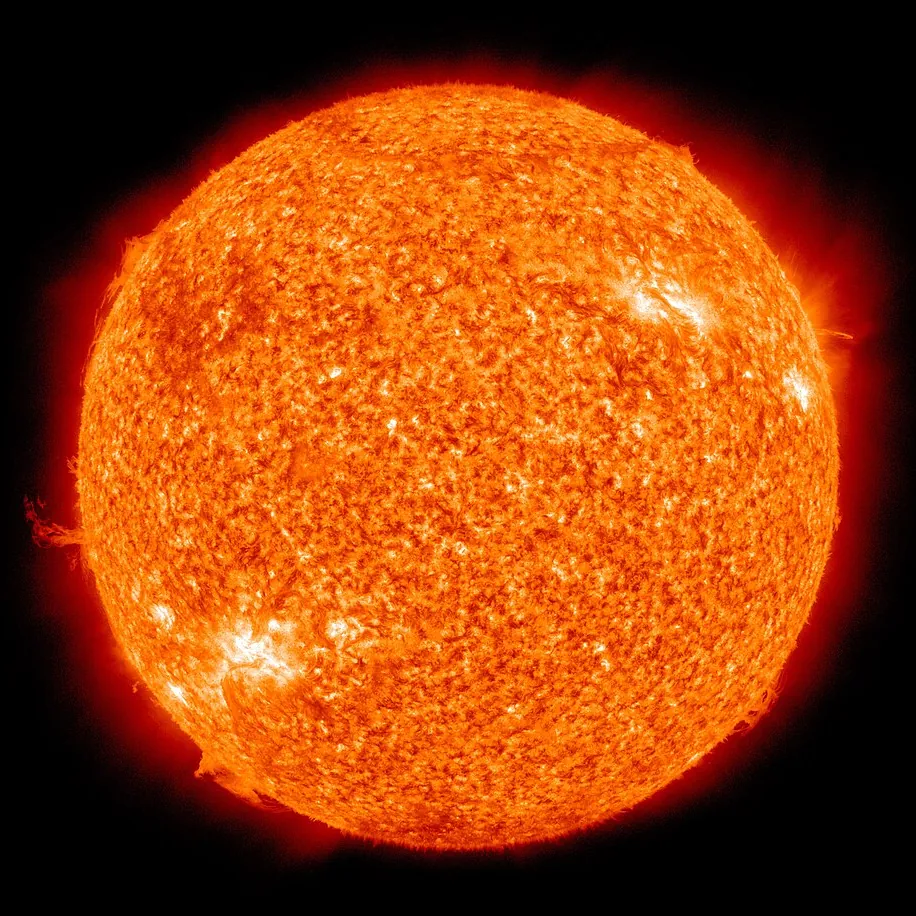
Each second the Sun turns about 600 million tonnes of hydrogen into helium, and in the process about 4 million tonnes of matter simply disappears, converted into energy. It has done this for 4.6 billion years and has lost less than a tenth of a percent of its mass. Until the 1920s nobody could explain what kept the Sun shining for so long. The answer came from $E = mc^2$.
What powers a star?
In the 1800s, the best idea was that the Sun was slowly shrinking, turning gravitational potential energy into heat. Lord Kelvin calculated that this could keep it shining for only about 30 million years, far less than geologists needed for the Earth's rocks and Darwin needed for evolution.
In 1920 Arthur Eddington pointed out that four hydrogen atoms have about 0.7% more mass than one helium atom. If the Sun could fuse hydrogen into helium, that mass difference would be released as energy, enough for billions of years. Cecilia Payne's 1925 result that the Sun is mostly hydrogen supplied the fuel, and in 1938–39 Hans Bethe worked out the reaction steps.
The Sun's luminosity is $3.83 \times 10^{26}$ W. How much mass does it convert to energy each second?
Each second the Sun radiates $E = 3.83 \times 10^{26}$ J.
$m = \dfrac{E}{c^2} = \dfrac{3.83 \times 10^{26}}{(3.00 \times 10^{8})^2} = 4.26 \times 10^{9}$ kg
About 4.3 million tonnes per second. Since the mass converted is 0.7% of the hydrogen fused, the Sun fuses about $4.26 \times 10^{9}/0.007 \approx 6 \times 10^{11}$ kg (600 million tonnes) of hydrogen each second.
The proton–proton chain
Fusion needs nuclei to get close enough (about $10^{-15}$ m) for the strong nuclear force to act, despite their electrostatic repulsion. That needs extremely high temperatures: about 10 to 15 million K in the Sun's core. Even then, most protons don't have enough kinetic energy to get over the repulsion. Fusion only happens because of quantum tunnelling, which gives a small chance of getting through the barrier.
In stars up to about 1.3 solar masses, including the Sun, most energy comes from the proton–proton (p–p) chain:
$$^1_1\text{H} + {}^1_1\text{H} \rightarrow {}^2_1\text{H} + {}^0_{+1}e + \nu_e$$
$$^2_1\text{H} + {}^1_1\text{H} \rightarrow {}^3_2\text{He} + \gamma$$
$$^3_2\text{He} + {}^3_2\text{He} \rightarrow {}^4_2\text{He} + 2\,{}^1_1\text{H}$$
The first step is extraordinarily slow, because one proton has to turn into a neutron by the weak interaction while the two protons are briefly close. An average proton in the Sun's core waits billions of years for it. That slowness is why the Sun lasts 10 billion years instead of exploding. The positrons annihilate with electrons immediately, adding their energy to the core.
Overall: $4\,{}^1_1\text{H} \rightarrow {}^4_2\text{He} + 2\,{}^0_{+1}e + 2\nu_e + 2\gamma$, releasing 26.7 MeV once the positrons have annihilated. A small fraction (about 2%) is carried away by the neutrinos, which pass straight out of the Sun.
Use atomic masses to calculate the energy released when four hydrogen atoms become one helium-4 atom. ($^1$H = 1.007825 u, $^4$He = 4.002603 u)
$\Delta m = 4 \times 1.007825 - 4.002603 = 4.031300 - 4.002603 = 0.028697$ u
$E = 0.028697 \times 931.5 = 26.73$ MeV
Atomic masses include the electrons. Four H atoms bring 4 electrons; the He atom keeps 2. The other 2 are exactly the electrons annihilated by the 2 positrons, so this answer already includes the annihilation energy. Fraction converted: $0.028697/4.0313 = 0.71\%$.
The CNO cycle
In stars more massive than about 1.3 solar masses, with core temperatures above about 17 million K, hydrogen is fused mainly through the carbon–nitrogen–oxygen (CNO) cycle. Carbon-12 acts as a catalyst: it captures protons one at a time, goes through nitrogen and oxygen isotopes with two β⁺ decays, and is returned at the end along with a new helium-4 nucleus.
$$^{12}\text{C} \xrightarrow{+p} {}^{13}\text{N} \xrightarrow{\beta^+} {}^{13}\text{C} \xrightarrow{+p} {}^{14}\text{N} \xrightarrow{+p} {}^{15}\text{O} \xrightarrow{\beta^+} {}^{15}\text{N} \xrightarrow{+p} {}^{12}\text{C} + {}^{4}\text{He}$$
The net reaction is the same as for the p–p chain, $4\,{}^1\text{H} \rightarrow {}^4\text{He} + 2e^+ + 2\nu_e$, so the same mass is converted and the same total energy is released. The difference is the rate. Each step has to push a proton into a nucleus with charge +6 or +7, so the electrostatic barrier is much higher. The CNO rate rises extremely steeply with temperature (roughly as $T^{17}$ or more, compared with about $T^4$ for the p–p chain). Below about 17 million K, the p–p chain wins; above it, the CNO cycle takes over.
In the Sun the CNO cycle supplies only about 1% of the energy. In 2020 the Borexino detector in Italy detected neutrinos from the Sun's CNO cycle for the first time, confirming Bethe's prediction directly.
| Proton–proton chain | CNO cycle | |
|---|---|---|
| Dominant in | Main-sequence stars below about 1.3 M☉ (including the Sun) | Main-sequence stars above about 1.3 M☉ |
| Core temperature | below about 17 million K | above about 17 million K |
| Net reaction | $4\,^1\text{H} \rightarrow {}^4\text{He} + 2e^+ + 2\nu_e$ | Same |
| Energy per He-4 | 26.7 MeV | 26.7 MeV |
| Catalyst needed | No | Yes: C, N and O nuclei, so the star must contain some heavier elements from earlier stars |
| Temperature sensitivity | Moderate | Extreme |
- With the p–p chain selected, press Next step until all seven reactions are done. Check the total: 26.7 MeV.
- Which single step releases the most energy? Which is the slowest, and why?
- Switch to the CNO cycle and step through it. Does the total come out the same? Which nucleus is used and then returned?
- Set the core temperature to 15.7 MK (the Sun's core). What share does the CNO cycle supply? (About 1%.)
- Find the temperature where the two processes contribute equally (about 18 MK in this simplified model). Then try 25 MK. What does this tell you about massive stars?
Post-main-sequence nucleosynthesis
When a star's core hydrogen runs out, the core contracts and heats up. At about 100 million K, helium nuclei can fuse by the triple-alpha process:
$$^4_2\text{He} + {}^4_2\text{He} \rightleftharpoons {}^8_4\text{Be}, \qquad {}^8_4\text{Be} + {}^4_2\text{He} \rightarrow {}^{12}_{\ 6}\text{C} + \gamma$$
Some carbon captures another helium nucleus to make oxygen: $^{12}\text{C} + {}^4\text{He} \rightarrow {}^{16}\text{O} + \gamma$. This is where almost all the carbon and much of the oxygen in the universe was made, including the atoms in your body.
In stars above about 8 solar masses the sequence continues, each stage needing a higher temperature and lasting a shorter time:
| Burning stage | Main products | Core temperature | Duration (25 M☉ star) |
|---|---|---|---|
| Hydrogen | He | 40 million K | 7 million years |
| Helium | C, O | 200 million K | 700 000 years |
| Carbon | Ne, Na, Mg | 800 million K | about 600 years |
| Neon | O, Mg | 1.5 billion K | about 1 year |
| Oxygen | Si, S | 2 billion K | about 6 months |
| Silicon | Fe, Ni | 3.5 billion K | about 1 day |
Fusion stops at iron and nickel because nuclei around mass number 56 have the highest binding energy per nucleon (page 8K). Fusing them further would absorb energy, not release it.
Making elements heavier than iron
Elements beyond iron are made by adding neutrons, which have no charge and so feel no repulsion. A nucleus captures neutrons until it becomes unstable, then β⁻ decays, turning a neutron into a proton and moving up one element.
- The s-process (slow neutron capture) happens in AGB stars over thousands of years. Each capture is usually followed by a β⁻ decay before the next capture. It makes about half the heavy elements, including much of the strontium, barium and lead.
- The r-process (rapid neutron capture) needs an enormous flood of neutrons, so that many are captured within seconds. It happens in neutron-star mergers and possibly some rare supernovae. In 2017 the merger GW170817 was detected by gravitational waves and then observed by telescopes worldwide, including Australian ones; its glow showed signs of freshly made heavy elements. Much of the gold, platinum and uranium in the universe was made this way.
Supernovae and stellar winds return all these elements to space, where they mix into new gas clouds. The Sun, formed 4.6 billion years ago, inherited elements made by generations of earlier stars. As astronomers like to say, we are made of star stuff.
Test yourself
Which of these is the net result of both the p–p chain and the CNO cycle?
Both routes turn four protons into one helium-4 nucleus.
Why does the CNO cycle dominate only in stars with hotter cores?
Higher nuclear charge means a higher Coulomb barrier, so the rate rises very steeply with temperature.
A star of 0.8 solar masses is on the main sequence. Its energy comes mainly from
Low-mass main-sequence stars have cooler cores, where the p–p chain dominates.
In the triple-alpha process, carbon-12 is formed from
3 × ⁴He → ¹²C, via the very short-lived ⁸Be.
A star converts $2.0 \times 10^{9}$ kg of mass to energy each second. Its luminosity is
$P = mc^2/t = 2.0 \times 10^{9} \times 9.0 \times 10^{16} = 1.8 \times 10^{26}$ W.
Label the nuclei in the CNO cycle.
In which stage does each process happen?
In the CNO cycle, carbon-12 acts as a . Each helium-4 nucleus made releases about MeV. Fusion in stars stops at because it has the highest binding energy per nucleon. Elements heavier than this are made by .
Compare the proton–proton chain and the CNO cycle as sources of energy in main-sequence stars.
Similarities. Both processes fuse four hydrogen nuclei into one helium-4 nucleus, emitting two positrons and two neutrinos. The products have 0.7% less mass than the reactants, so both release the same energy, 26.7 MeV per helium-4 nucleus ($E = mc^2$). Both occur in the cores of main-sequence stars.
Differences. The p–p chain fuses protons directly, via deuterium and helium-3. The CNO cycle uses carbon-12 as a catalyst: protons are added to C, N and O nuclei (with two β⁺ decays) and carbon-12 is returned at the end. Because C, N and O have charges of +6 to +8, the electrostatic barrier is much larger, so the CNO cycle needs higher temperatures and its rate rises far more steeply with temperature. As a result, the p–p chain dominates in stars up to about 1.3 solar masses with core temperatures below about 17 million K, including the Sun (about 99% of its energy), while the CNO cycle dominates in more massive, hotter stars. The CNO cycle also requires the star to contain carbon, nitrogen or oxygen made by earlier generations of stars.
The CNO step $^{14}\text{N} + {}^1\text{H} \rightarrow {}^{15}\text{O} + \gamma$ involves the masses $^{14}$N = 14.003074 u, $^1$H = 1.007825 u and $^{15}$O = 15.003066 u. Calculate the energy released, in MeV and in joules.
$\Delta m = (14.003074 + 1.007825) - 15.003066 = 0.007833$ u. $E = 0.007833 \times 931.5 = 7.30$ MeV $= 7.30 \times 10^{6} \times 1.602 \times 10^{-19} = 1.17 \times 10^{-12}$ J.