 Coaching Centre
Satellites and orbits
Newton's cannon, deriving orbital velocity and period from gravity as the centripetal force, low Earth orbits and geostationary orbits, apparent weightlessness, and orbital decay.
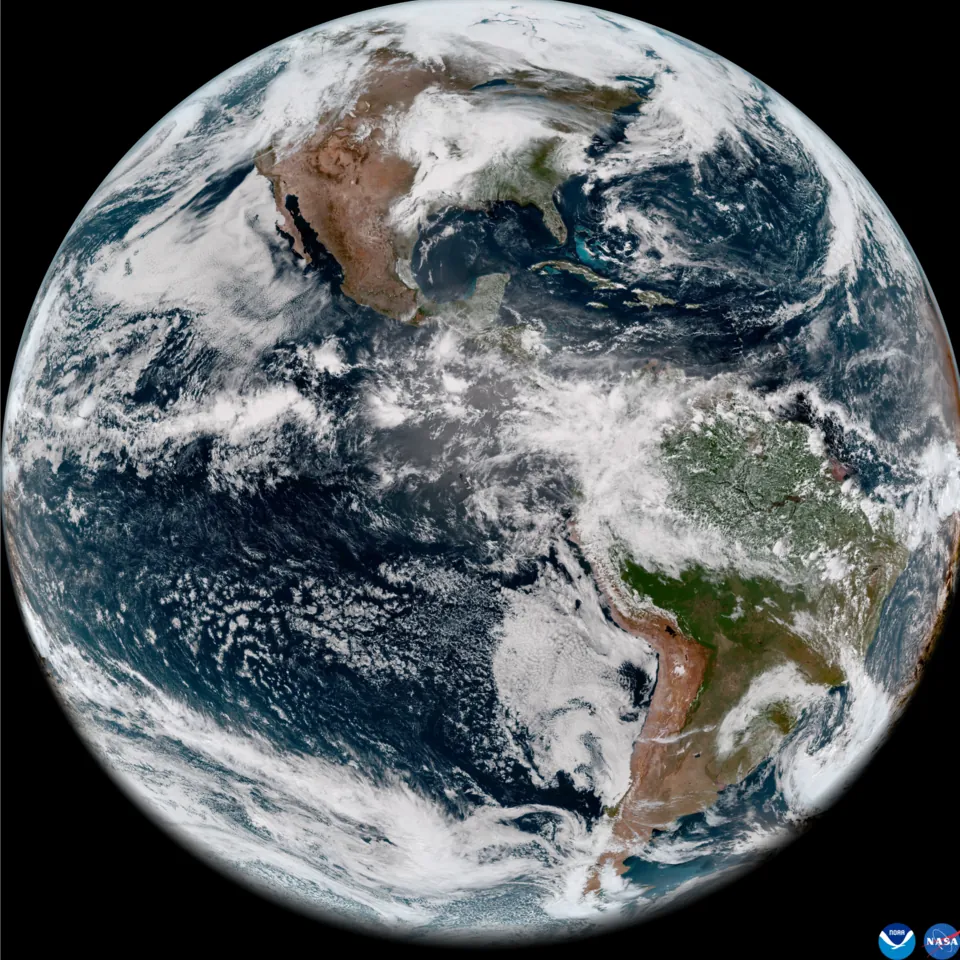
Right now, about 35 800 km above the equator north of Australia, a Japanese weather satellite called Himawari is moving at over 11 000 km/h. Yet from the ground it never moves at all. Every ten minutes it photographs our half of the planet, and those images become the satellite loops on the evening weather report.
A satellite is a projectile that never lands. This page shows how that's possible and derives the speed and period of any circular orbit, then applies them to the two orbits the syllabus names: low Earth orbit and geostationary orbit.
Newton's cannon
Newton imagined a cannon on a mountain so tall it pokes out of the atmosphere, firing horizontally. A slow shot falls to the ground nearby. A faster shot lands further away, and because Earth is curved, the ground falls away beneath it as it travels. At just the right speed, the shot falls towards Earth at exactly the rate the surface curves away. It falls forever without getting closer: it is in orbit. Faster still, the orbit becomes an ellipse, and above escape speed the shot leaves Earth for good.
So orbiting is falling. A satellite's acceleration is $g$ at its height, directed at Earth's centre. That is exactly the centripetal acceleration it needs to follow its circle.
Orbital speed and period
For a satellite of mass $m$ in a circular orbit of radius $r$ around a planet of mass $M$, gravity provides the centripetal force:
$\dfrac{GMm}{r^2} = \dfrac{mv^2}{r} \quad\Rightarrow\quad v = \sqrt{\dfrac{GM}{r}}$
Combining with $v = 2\pi r/T$ gives the period:
$T = 2\pi\sqrt{\dfrac{r^3}{GM}}$
The satellite's mass cancels. A 1 kg CubeSat and the 420-tonne ISS at the same height travel at the same speed. Higher orbits are slower and have longer periods. Remember that $r$ is measured from the centre of the planet.
The ISS orbits 408 km above Earth's surface. Using data-sheet values, find its orbital speed and period.
Low Earth orbit and geostationary orbit
| Low Earth orbit (LEO) | Geostationary orbit (GEO) | |
|---|---|---|
| Altitude | about 160 to 2000 km | 35 786 km, above the equator only |
| Speed | about 7.5 to 7.8 km/s | 3.07 km/s |
| Period | about 90 to 130 minutes | one sidereal day (23 h 56 min) |
| View from the ground | races across the sky in minutes | stays fixed over one point |
| Uses | ISS, Earth imaging, Starlink internet, GRACE | weather (Himawari), TV broadcasting, NBN Sky Muster, SouthPAN positioning |
| Strengths | close, so detailed images and short signal delay; cheap to reach | a fixed dish can point at it; sees almost a whole hemisphere |
A geostationary satellite has a period equal to Earth's rotation, orbits above the equator, and moves in the same direction Earth spins. It stays over the same point on the ground. Because $T$ fixes $r$, there is only one possible geostationary altitude, and that ring of space is crowded with satellites.
Find the altitude of a geostationary orbit. Use $T = 24$ h and data-sheet values.
The accepted value is 35 786 km. The small difference comes from rounding $M_E$ and from using 24 h. Earth actually turns once relative to the stars every 23 h 56 min (a sidereal day); the extra four minutes in a solar day are because Earth has also moved along its orbit around the Sun.
- Fire at 5 km/s, then 7 km/s. How far around the Earth does each shot get before it crashes?
- The circular orbit speed 1000 km up is 7.35 km/s. Fire at 7.3 or 7.4 km/s to get a very nearly circular orbit, then try 9 km/s. What shape is the orbit now, and where is the shell fastest?
- Fire at 10.5 km/s, just above the escape speed of 10.40 km/s.
- Switch to Circular orbit calculator. Press ISS, GPS and Geostationary. You should get 7.67 km/s and 1 h 33 min, 3.87 km/s and 11 h 58 min, and 3.07 km/s and 23 h 56 min.
Apparent weightlessness
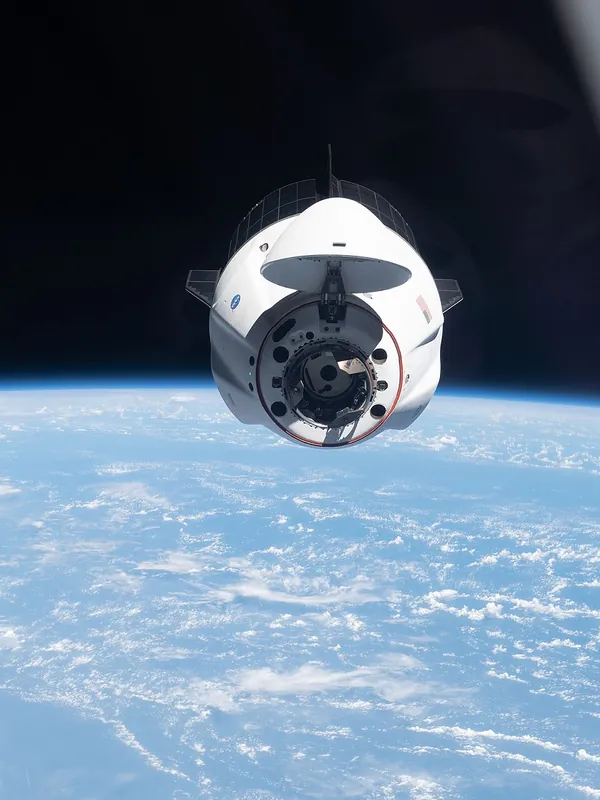
Astronauts on the ISS float, but gravity there is still 88% of its surface value. What they've lost is apparent weight, the push of the floor on their feet, which is what bathroom scales measure and what your body senses as weight. The astronaut and the station fall towards Earth with the same acceleration, so the floor never needs to push. The same thing happens briefly at the top of a roller-coaster hill, in a falling lift, or in the "vomit comet" aircraft that flies parabolas to train astronauts.
Orbital decay
In low Earth orbit there is still a trace of atmosphere. Drag removes energy, and the satellite drops gradually into a lower orbit. (Strangely, it speeds up as it does, because lower orbits are faster.) The process accelerates as the air gets thicker, and eventually the satellite re-enters and mostly burns up. The ISS loses about 2 km of height a month and is regularly boosted by engines on docked spacecraft.
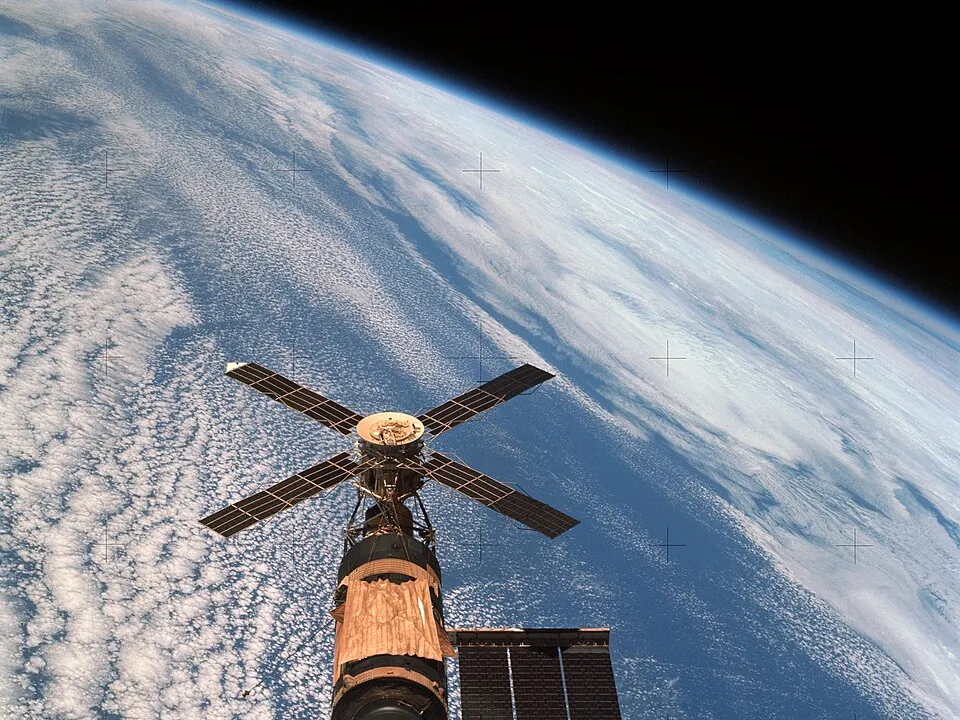
When the Sun is active, it heats and expands the upper atmosphere, increasing drag. That is what brought down Skylab, the first US space station, sooner than expected. In July 1979 it broke up over the Indian Ocean and scattered pieces across the area around Esperance, in Western Australia. The local shire issued NASA a tongue-in-cheek 400-dollar fine for littering.
Test yourself
Satellite X orbits at twice the radius of satellite Y. Compared with Y, satellite X has
$v \propto 1/\sqrt r$ and $T \propto r^{3/2}$.
Which statement about a geostationary satellite is correct?
Only one radius gives a one-day period, and it must be equatorial to stay over one point.
An astronaut on the ISS feels weightless because
Both accelerate at $g$ towards Earth, so there is no normal force.
A satellite orbits Earth at a radius of $8.0 \times 10^6$ m. Using data-sheet values, its orbital speed is closest to
$v = \sqrt{4.0 \times 10^{14}/8.0 \times 10^6} = \sqrt{5.0 \times 10^7} = 7.07$ km/s.
Label the orbits.
Which orbit fits each description?
In a circular orbit, provides the centripetal force. A higher orbit has a speed and a longer period. A geostationary satellite orbits above the with the same period as Earth's rotation. Astronauts feel weightless because they are in . Drag from the thin upper atmosphere causes orbital .
Derive an expression for the radius of a geostationary orbit, and use it to calculate the altitude of a geostationary satellite above Earth's surface. Explain why all geostationary satellites must be at this altitude.
Gravity provides the centripetal force: $\dfrac{GMm}{r^2} = \dfrac{mv^2}{r}$, so $v^2 = \dfrac{GM}{r}$. For a circular orbit $v = \dfrac{2\pi r}{T}$, so $\dfrac{4\pi^2r^2}{T^2} = \dfrac{GM}{r}$, giving $r^3 = \dfrac{GMT^2}{4\pi^2}$.
A geostationary satellite has $T$ = 1 day = 86 400 s. Then $r^3 = \dfrac{(6.67 \times 10^{-11})(6.0 \times 10^{24})(86\,400)^2}{4\pi^2} = 7.57 \times 10^{22}$, so $r = 4.23 \times 10^7$ m. Altitude $= 4.23 \times 10^7 - 6.37 \times 10^6 = 3.59 \times 10^7$ m (about 36 000 km).
To stay above one point, the satellite's period must equal Earth's rotation period. The expression shows that $r$ depends only on $T$ and Earth's mass, not on the satellite's mass, so every geostationary satellite must have the same orbital radius.