 Coaching Centre
Banked tracks and vertical loops
Cars on flat and banked curves, deriving the design speed of a banked track, the role of friction above and below the design speed, conical pendulums, and the forces on a rider in a vertical loop.
Track cycling velodromes are banked at up to about 45°. Stand at the top of the bend and it feels like a wall. Yet a rider at full speed sits on that slope without sliding down, and without needing much sideways grip from their tyres at all. The tilt of the track is doing the work.
In 5D, the centripetal force was provided by a single obvious force. Here it comes from a combination of forces, so the skill is resolving them. Always start with a force diagram, and remember that the centripetal force is horizontal (towards the centre of a horizontal circle), not down the slope.
Cars on flat curves
On a flat road, the only horizontal force on a car is sideways friction from the road on the tyres. The vertical forces balance ($N = mg$), and friction provides the centripetal force:
$f = \dfrac{mv^2}{r}$
Friction can only rise to a maximum of $\mu N = \mu mg$, where $\mu$ is the coefficient of friction. So the fastest safe speed is when $\mu mg = mv^2/r$:
$v_{\max} = \sqrt{\mu g r}$
Mass cancels: a truck and a hatchback have the same limit on the same bend (if their tyres grip equally). On a dry road ($\mu \approx 0.7$) with a 50 m radius, $v_{\max} = \sqrt{0.7 \times 9.8 \times 50} = 18.5$ m/s, about 67 km/h. On a wet road ($\mu \approx 0.4$) it drops to 14.0 m/s (50 km/h), and on ice almost nothing is safe.
Banked curves
On a road tilted at angle $\theta$, the normal force is perpendicular to the road surface, so it tilts towards the centre of the curve. Its horizontal component $N\sin\theta$ can provide the centripetal force with no friction at all. At this design speed:
- vertically, forces balance: $N\cos\theta = mg$
- horizontally, the net force is centripetal: $N\sin\theta = \dfrac{mv^2}{r}$
Dividing the second equation by the first:
$\tan\theta = \dfrac{v^2}{rg}$
Again, mass cancels. Every vehicle can take the curve at the same design speed without relying on friction.
(a) A curve of radius 200 m is banked at 10°. Find its design speed. (b) A motorway exit with a radius of 300 m is to be designed for 100 km/h. What bank angle is needed?
Faster or slower than the design speed
Real cars don't all travel at the design speed. Friction takes up the difference:
- Faster than the design speed, the car needs more centripetal force than $N\sin\theta$ provides. The car tends to slide up and out, so friction acts down the slope, adding an inward component.
- Slower than the design speed, $N\sin\theta$ is more than needed. The car tends to slide down the bank, so friction acts up the slope.
If the friction needed is more than the road can supply, the car slides. That's why a steeply banked track can be dangerous for a slow car on ice: it slides down into the inside of the curve.
- At the start (10° bank, 200 m radius), the design speed reads 18.6 m/s, or 67 km/h, matching the worked example. Set the speed to 66 or 68 km/h and watch the friction needed fall to under 100 N, tiny compared with the 10 000 N or so available.
- Choose Ice and raise the speed to 108 km/h. The car needs 4095 N of friction down the slope, but only 1565 N is available. What happens?
- Still on ice, set the bank to 30° and the speed to 20 km/h. Now which way does it slide, and why?
- On a flat road (0°), find the highest speed the car can take a 200 m bend when dry and when wet. Check with $v = \sqrt{\mu g r}$: you should get about 133 km/h and 101 km/h.
The conical pendulum
A mass on a string swung in a horizontal circle, with the string at angle $\theta$ to the vertical, is a conical pendulum. The forces are tension and weight. Vertically $T\cos\theta = mg$; horizontally $T\sin\theta = mv^2/r$. Dividing gives $\tan\theta = v^2/rg$, exactly the banked-track result, because the geometry is the same: a single tilted force supports the weight and supplies the centripetal force. A chair-swing ride at a fair works this way; the chairs swing out further as the ride speeds up.
Vertical loops
In a vertical circle the speed changes (the rider slows going up), so it isn't uniform circular motion, but at the top and bottom we can still apply $F_{\text{net}} = mv^2/r$ towards the centre.
At the bottom, the centre is above. The seat pushes up with $N$ and weight acts down:
$N - mg = \dfrac{mv^2}{r} \quad\Rightarrow\quad N = mg + \dfrac{mv^2}{r}$
The seat pushes harder than your weight, so you feel heavy.
At the top, the centre is below. Both the seat (now above you) and gravity push down:
$N + mg = \dfrac{mv^2}{r} \quad\Rightarrow\quad N = \dfrac{mv^2}{r} - mg$
If the rider goes slowly enough that $N$ would be negative, they fall out of the circle (which is why roller coasters lock riders in and keep wheels on both sides of the track). The minimum speed at the top is when $N = 0$, so gravity alone provides the centripetal force:
$mg = \dfrac{mv^2}{r} \quad\Rightarrow\quad v_{\min} = \sqrt{gr}$
A roller-coaster loop has a radius of 10 m. (a) What is the minimum speed at the top? (b) A 60 kg rider passes the bottom at 20 m/s. Find the normal force from the seat, and compare it with the rider's weight.
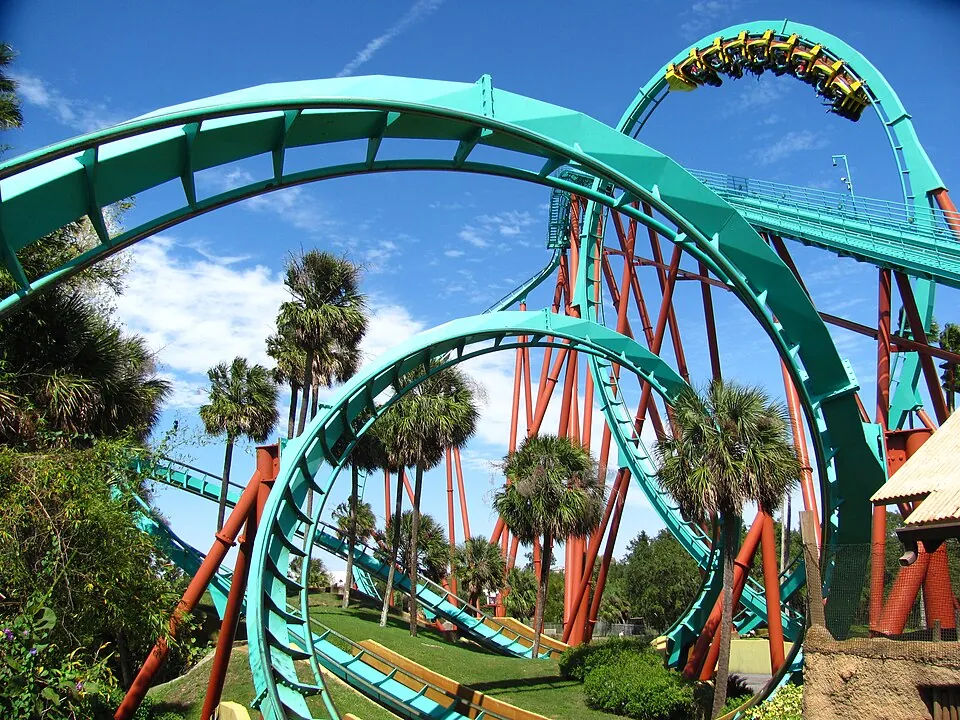
That 5 g is uncomfortable and dangerous, so modern loops aren't circles. They are tall teardrop shapes (clothoid loops) with a tight radius at the top, where the rider is slow, and a wide radius at the bottom, where the rider is fast. That keeps $v^2/r$, and so the forces, more even all the way round.
Test yourself
A car takes a banked curve at exactly the design speed. Which force provides the centripetal force?
At the design speed no friction is needed; $N\sin\theta$ points towards the centre.
A curve of radius 120 m is to have a design speed of 72 km/h. The bank angle required is closest to
$v = 20$ m/s; $\tan\theta = 400/(120 \times 9.8) = 0.340$, $\theta = 18.8°$.
A car travels a banked curve faster than the design speed without sliding. The friction on its tyres acts
The car tends to slide outward and up, so friction acts down the slope, adding to the inward force.
A roller-coaster car goes over the top of a circular loop of radius 8.0 m at 12 m/s. The force from the seat on a 50 kg rider is closest to
$N = mv^2/r - mg = 50 \times 144/8 - 490 = 900 - 490 = 410$ N, acting downward (towards the centre).
Label the forces on a car on a banked curve.
On a curve banked for 60 km/h, which way does friction act on the car?
On a flat bend, the centripetal force is provided by . On a banked bend at the design speed, it is provided by the horizontal component of the force. The design speed does not depend on the vehicle's . At the bottom of a vertical loop the rider feels than normal. The minimum speed at the top of a loop is the square root of g times the .
A car of mass 1200 kg travels around a curve of radius 150 m banked at 12°. (a) Derive an expression for the design speed of a banked curve, and calculate it for this curve. (b) Explain, with reference to forces, what happens if the car travels the curve at 30 m/s on an icy road.
(a) At the design speed only weight $mg$ (down) and the normal force $N$ (perpendicular to the road) act. Vertically there is no acceleration: $N\cos\theta = mg$. Horizontally the net force is centripetal: $N\sin\theta = mv^2/r$. Dividing: $\tan\theta = v^2/(rg)$, so $v = \sqrt{rg\tan\theta} = \sqrt{150 \times 9.8 \times \tan12°} = \sqrt{312.5} = 17.7$ m/s (about 64 km/h).
(b) At 30 m/s the car needs $mv^2/r = 1200 \times 900/150 = 7200$ N of centripetal force, much more than $N\sin\theta$ provides. To stay on the curve, friction would have to act down the slope to make up the difference. On ice the coefficient of friction is very small, so the maximum friction is far too small. The net inward force is less than $mv^2/r$, so the car follows a wider path, sliding up the bank and out of the curve.