 Coaching Centre
Cathode rays and the electron
The discovery of the electron: investigations of cathode rays in evacuated tubes, the particle-or-wave debate, Thomson's measurement of the charge-to-mass ratio with crossed electric and magnetic fields, and Millikan's oil-drop experiment showing that charge is quantised.
In 1897 J. J. Thomson announced that the atom, the indivisible building block of matter since the ancient Greeks, had pieces. The pieces were nearly 2000 times lighter than a hydrogen atom and were identical no matter which metal or gas they came from. Thomson called them "corpuscles". We call them electrons, and every phone, screen and power line depends on them.
Cathode rays
From the 1850s, physicists studied what happened when a high voltage was connected across two electrodes sealed in a glass tube from which most of the air had been pumped. As the pressure fell, the gas glowed in coloured bands; at very low pressure the glow faded and the glass opposite the negative electrode (the cathode) began to glow green. Something was streaming from the cathode. Eugen Goldstein named it cathode rays in 1876.
There were two competing models. Many German physicists thought cathode rays were a wave in the aether, like light. Many British physicists thought they were a stream of charged particles. Experiments gave evidence on both sides:
| Observation | Who and when | What it suggested |
|---|---|---|
| An object in the path (a Maltese cross) casts a sharp shadow on the glass | Crookes, Goldstein, 1870s | Rays travel in straight lines from the cathode (consistent with both models) |
| A small paddle wheel in the beam is pushed round | Crookes, 1879 | Rays carry momentum, so particles. (It was later shown the wheel was mostly driven by heating, so this was weak evidence.) |
| Rays are deflected by a magnet in the direction expected for negative charges | Plücker, 1858; Crookes | Charged particles |
| No deflection by an electric field | Hertz, 1883 | Not charged, so a wave. (The gas left in the tube was ionised and shielded the plates.) |
| Rays pass through thin metal foils | Hertz, Lenard, 1892 | A wave, since atoms were thought to be solid |
| Rays carry negative charge into a collector | Perrin, 1895 | Negatively charged particles |
| Rays are the same whatever the cathode metal or gas | Thomson, 1897 | A universal constituent of matter |
Thomson settled the argument in 1897. With a much better vacuum he showed that cathode rays are deflected by an electric field, towards the positive plate. They were negatively charged particles. He then measured how much charge they carry per kilogram.
Thomson's charge-to-mass experiment
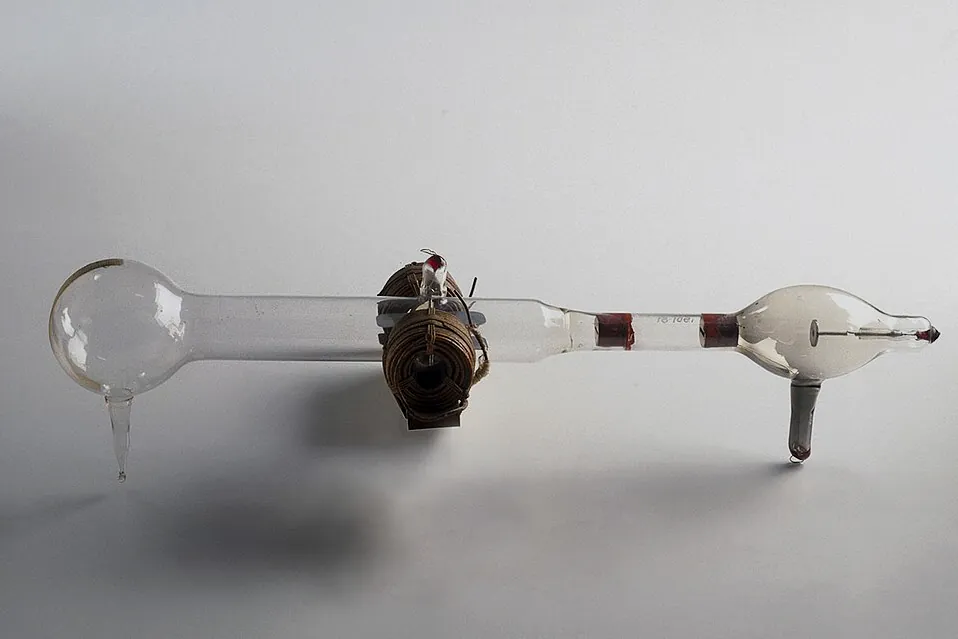
Thomson's tube had parallel plates to make a uniform electric field and coils to make a uniform magnetic field at right angles to it, both perpendicular to the beam. His method had two stages.
Stage 1: find the speed. Switch on both fields and adjust them until the beam is undeflected. The electric and magnetic forces are then equal and opposite:
$$qE = qvB \quad\Rightarrow\quad v = \frac{E}{B}$$
where the field between plates is $E = V/d$. The particles' speed depends only on the two field strengths, not on their charge or mass. This arrangement is a velocity selector.
Stage 2: find q/m. Switch off the electric field. The magnetic force alone provides a centripetal force, so the beam moves in a circular arc of radius $r$:
$$qvB = \frac{mv^2}{r} \quad\Rightarrow\quad \frac{q}{m} = \frac{v}{Br} = \frac{E}{B^2 r}$$
Thomson found the same $q/m$ for every cathode metal and every gas. It was about 1000 times larger than that of the hydrogen ion found in electrolysis (the largest then known). Either the particles carried a huge charge or they had a tiny mass. Thomson argued for a tiny mass, and that they were a part of every atom. The modern value is $1.759 \times 10^{11}$ C kg−1, about 1836 times the hydrogen ion's value.
In a Thomson-type experiment, plates 5.0 cm apart have 2000 V across them. The beam goes straight when a magnetic field of 1.51 mT is applied. With the electric field switched off, the beam curves with a radius of 10.0 cm. Find the speed of the electrons and their charge-to-mass ratio.
$E = \dfrac{V}{d} = \dfrac{2000}{0.050} = 4.0 \times 10^{4}$ V m−1
$v = \dfrac{E}{B} = \dfrac{4.0 \times 10^{4}}{1.51 \times 10^{-3}} = 2.65 \times 10^{7}$ m s−1, almost 9% of the speed of light.
$\dfrac{q}{m} = \dfrac{v}{Br} = \dfrac{2.65 \times 10^{7}}{1.51 \times 10^{-3} \times 0.100} = 1.76 \times 10^{11}$ C kg−1
- Keep the accelerating voltage at 2000 V and the plate voltage at 2000 V. With $B$ = 1 mT, which way does the beam bend, and why?
- Adjust $B$ until the beam goes straight. You should need about 1.51 mT. Check that the speed readout is $v = E/B \approx 2.65 \times 10^{7}$ m/s.
- Now switch the electric field off without touching $B$. Read the radius (about 10.0 cm) and the charge-to-mass ratio (about $1.76 \times 10^{11}$ C/kg).
- Increase the accelerating voltage to 4000 V and repeat. Does $q/m$ change? What do $v$ and $r$ do?
- Explain why Thomson needed both stages: what can't you find from the magnetic deflection alone?
Millikan's oil-drop experiment
Thomson had the ratio $q/m$ but not $q$ or $m$ separately. Between 1909 and 1913 Robert Millikan and his student Harvey Fletcher measured the charge directly.
A fine spray of oil drops was squirted above two horizontal parallel plates. Some drops fell through a small hole into the space between the plates, where X-rays (or friction from the sprayer) gave them a small electric charge. Watching through a microscope, Millikan could:
- Switch the plates off and time a drop falling at its terminal velocity. Using Stokes' law for air resistance, this gave the drop's radius and so its mass.
- Switch on the voltage and adjust it until the drop hung still. Then the electric force balanced the weight:
$$qE = mg \quad\Rightarrow\quad q = \frac{mg}{E} = \frac{mgd}{V}$$
Millikan measured hundreds of drops. Every charge was a whole-number multiple of one smallest value, about $1.6 \times 10^{-19}$ C. Charge is quantised: it comes in lumps of the elementary charge $e$. Combined with Thomson's $q/m$, this gave the electron's mass: $m_e = e/(q/m) = 9.1 \times 10^{-31}$ kg, about 1/1836 of a hydrogen atom.
Since the 2019 redefinition of the SI units, the elementary charge is defined to be exactly $e = 1.602\,176\,634 \times 10^{-19}$ C. The kilogram, ampere and other units are now built from fixed constants like this, rather than from physical objects.
An oil drop of mass $2.40 \times 10^{-15}$ kg is held stationary between plates 6.0 mm apart when the voltage is 294 V. Find its charge and the number of excess electrons.
$q = \dfrac{mgd}{V} = \dfrac{2.40 \times 10^{-15} \times 9.8 \times 6.0 \times 10^{-3}}{294} = 4.80 \times 10^{-19}$ C
$n = \dfrac{4.80 \times 10^{-19}}{1.602 \times 10^{-19}} = 3.0$, so the drop carries 3 excess electrons. The upper plate must be positive to pull the negative drop up.
- Adjust the plate voltage until the drop hangs still (the force ratio reads 1.000). Press Record charge. How many multiples of $1.602 \times 10^{-19}$ C is it?
- Spray a new drop and repeat for at least six drops. Look at the dot plot: what do you notice about where the charges fall?
- Find the largest value that every recorded charge is a whole-number multiple of. That is your measurement of $e$.
- Try recording while the drop is still moving. Why does the simulation refuse, and what would this do to Millikan's results?
Test yourself
In Thomson's experiment, a beam passes undeflected through crossed fields of $E = 3.0 \times 10^{4}$ V m⁻¹ and $B = 1.5 \times 10^{-3}$ T. The speed of the electrons is
$v = E/B = 3.0 \times 10^{4} / 1.5 \times 10^{-3} = 2.0 \times 10^{7}$ m s⁻¹.
Which observation was the strongest evidence that cathode rays are a universal part of matter?
Identical particles from every substance suggested they are a constituent of all atoms.
Why did Hertz find no deflection of cathode rays by an electric field?
Thomson repeated it with a better vacuum and found a clear deflection.
An oil drop carries a charge of $6.4 \times 10^{-19}$ C. The number of excess electrons it carries is
$6.4 \times 10^{-19} / 1.6 \times 10^{-19} = 4$.
In Millikan's experiment, a drop is held still. If the voltage is doubled, the drop will
The electric force doubles while the weight stays the same, so there is a net upward force.
Label Millikan's apparatus.
Which model of cathode rays did each observation support at the time?
Thomson balanced electric and magnetic forces, so $qE = $ . With only the magnetic field on, the electrons move in a path. Millikan showed that charge is , coming in multiples of C. Cathode rays turned out to be streams of .
Assess how the experiments of Thomson and Millikan together established the properties of the electron. Include relevant equations and explain how each experiment's measurements were used.
Thomson showed cathode rays are deflected by both electric and magnetic fields, so they are charged particles. He adjusted crossed fields until the beam was undeflected, so $qE = qvB$ and $v = E/B$. Then, with the magnetic field alone, the beam followed a circle: $qvB = mv^2/r$, so $q/m = v/(Br) = E/(B^2r)$. The ratio was the same for every cathode material and gas and about 1800 times that of a hydrogen ion. This showed the particles are a universal constituent of atoms, and suggested they are much lighter than atoms, but it could not separate charge from mass.
Millikan balanced charged oil drops between horizontal plates, so $qE = mg$ and $q = mgd/V$, finding each drop's mass from its terminal fall speed. Every charge was a whole-number multiple of $1.6 \times 10^{-19}$ C, showing that charge is quantised and this is the charge of one electron.
Combining the two results gives $m_e = e \div (q/m) = 1.60 \times 10^{-19} / 1.76 \times 10^{11} = 9.1 \times 10^{-31}$ kg, about 1/1836 of a hydrogen atom. Neither experiment alone fixes both charge and mass, so the two together were needed to establish the electron as a light, negatively charged particle with a fixed, smallest unit of charge. The results were reliable: Thomson's ratio was repeated across many materials and Millikan measured hundreds of drops, though his value of $e$ was about 0.6% low because of an error in the viscosity of air.