 Coaching Centre
Gravitational fields
Newton's law of universal gravitation, gravitational field strength g = GM/r², field-line diagrams, the inverse square law, how g varies over Earth and with altitude, and measuring gravity from orbit.
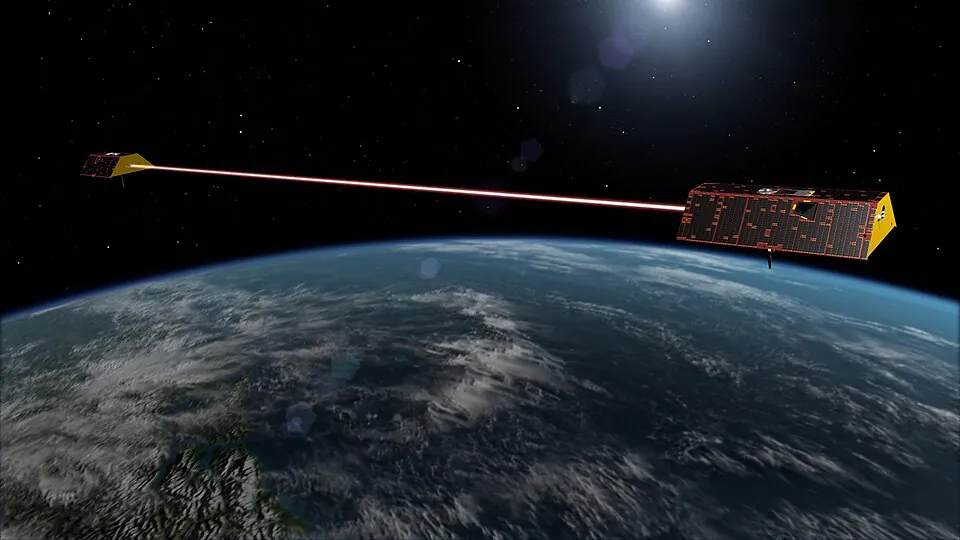
Since 2002, two satellites have chased each other around Earth about 220 km apart, measuring the gap between them to within a few micrometres. When the leading one passes over a mountain range, or over a basin full of groundwater, it is tugged slightly ahead. From those tiny changes, the GRACE missions weigh the water under Australia's farms from 500 km up, and they watched the Murray–Darling Basin lose groundwater through the Millennium Drought.
This module now moves from circles to orbits, and the force behind every orbit is gravity. This page sets up the two equations everything else is built on: the force between two masses, and the gravitational field around one.
Newton's law of universal gravitation
Every mass attracts every other mass. For two masses $M$ and $m$ whose centres are a distance $r$ apart:
$F = \dfrac{GMm}{r^2}$
$G = 6.67 \times 10^{-11}\ \text{N m}^2\,\text{kg}^{-2}$ is the universal gravitational constant. It's tiny, which is why you don't feel the pull of the person next to you (about $10^{-7}$ N), and why gravity only matters when at least one of the masses is planet-sized.
Three features to know:
- It is an inverse square law: double the distance and the force drops to a quarter; triple it and the force is one-ninth.
- Distance is measured between centres. For a satellite, $r$ = planet's radius + altitude.
- The forces form a Newton's third law pair: Earth pulls the Moon exactly as hard as the Moon pulls Earth. The Moon simply responds more, because its mass is smaller.
Earth's mass is $6.0 \times 10^{24}$ kg, the Moon's is $7.35 \times 10^{22}$ kg and their centres are $3.84 \times 10^8$ m apart. Find the gravitational force between them.
Gravitational field strength
A gravitational field is the region around a mass where another mass feels a force. The field strength $g$ is the force per kilogram on a small test mass placed there: $g = F/m$. Dividing Newton's law by $m$:
$g = \dfrac{GM}{r^2}$
The units of $g$ are N kg⁻¹, which are the same as m s⁻². It is both the force on each kilogram and the acceleration of anything in free fall there. It depends only on the mass $M$ creating the field and the distance from its centre, not on the object placed in it.
Field lines show the direction a test mass would accelerate. Around a planet they point radially inward. Closer lines mean a stronger field. Near Earth's surface, over a region much smaller than Earth, the lines are almost parallel and evenly spaced: the field is close to uniform, which is the assumption we used for projectiles.
Using the data sheet ($M_E = 6.0 \times 10^{24}$ kg, $R_E = 6.371 \times 10^6$ m), find $g$ at Earth's surface and at the ISS, 408 km up. Find the ISS value as a percentage of the surface value.
So gravity at the ISS is far from zero. Astronauts float because they and the station are falling together, which is the subject of 5H.
The data-sheet mass gives 9.86 rather than the familiar 9.8 because it is rounded to two significant figures (the precise value is $5.97 \times 10^{24}$ kg). Use the data sheet values in exams; the markers expect them.
What affects g
From $g = GM/r^2$, a planet with more mass has a stronger surface field, and a planet with a larger radius has a weaker one, for the same mass. Mars has about one-ninth of Earth's mass but just over half its radius, so its surface $g$ is $3.7\ \text{N kg}^{-1}$, about 38% of Earth's. Jupiter is 318 times as massive as Earth but 11 times as wide, so its "surface" (cloud-top) $g$ is only about 2.5 times Earth's.
On Earth itself, $g$ isn't exactly the same everywhere:
- Latitude: about 9.78 N kg⁻¹ at the equator and 9.83 N kg⁻¹ at the poles. Earth bulges at the equator (you are further from the centre) and the spin means part of gravity's pull is used as centripetal force.
- Altitude: $g$ falls by about 0.3% for every 10 km up.
- Local geology: dense ore bodies give a slightly stronger field; low-density sediments or salt domes a weaker one. Mineral explorers in Australia map these tiny differences with gravimeters, from the ground and from aircraft.
- On Earth, the surface field is 9.82 N/kg. Move to 2 radii from the centre: the field is 2.45 N/kg, a quarter. Try 3 radii and 4 radii. Is it an inverse square law?
- Press ISS. What percentage of surface gravity does an astronaut there still feel?
- Compare the surface fields of the Moon, Mars and Jupiter. Which has the strongest gravity, and is it the biggest factor of mass you'd expect?
- Press Geostationary. How much does a 70 kg astronaut "weigh" there?
Test yourself
A satellite is moved from 2 Earth radii to 4 Earth radii from Earth's centre. The gravitational force on it becomes
The distance doubles, so the force is divided by $2^2 = 4$.
Mars has a mass of $6.42 \times 10^{23}$ kg and a radius of $3.39 \times 10^6$ m. The gravitational field strength at its surface is closest to
$g = 6.67 \times 10^{-11} \times 6.42 \times 10^{23} / (3.39 \times 10^6)^2 = 3.73$ N kg⁻¹.
The Moon pulls on Earth with a force of $2.0 \times 10^{20}$ N. The force of Earth on the Moon is
Newton's third law pair.
Which of these does not affect the gravitational field strength at a point near a planet?
$g = GM/r^2$ involves only the field-making mass and the distance.
Label the gravitational field between Earth and the Moon.
Order by surface gravitational field strength, weakest first.
The gravitational force between two masses is inversely proportional to the of the distance between their centres. Gravitational field strength is the force per unit , with units of N/kg. At the ISS, the field is about of its surface value. Field lines point the mass creating the field. $g$ is slightly greater at the than at the equator.
A newly discovered planet has three times the mass of Earth and 1.5 times Earth's radius. (a) Calculate the gravitational field strength at its surface, taking $g = 9.8$ N kg⁻¹ on Earth. (b) A 100 kg rover on the planet's surface is moved to a height of one planet radius above the surface. Find the gravitational force on it there.
(a) $g \propto M/r^2$, so $g_P = 9.8 \times \dfrac{3}{1.5^2} = 9.8 \times 1.33 = 13.1$ N kg⁻¹.
(b) One planet radius above the surface is 2 radii from the centre. The distance doubles, so $g$ falls to a quarter: $13.1/4 = 3.27$ N kg⁻¹. The force is $F = mg = 100 \times 3.27 = 327$ N.