 Coaching Centre
Deep inside the atom
Evidence that protons and neutrons are made of quarks, the particle zoo and new particles from cosmic rays and accelerators, the Standard Model of matter with quarks, leptons and force-carrying bosons, the quark composition of hadrons, conservation laws in particle reactions, and how linear accelerators, cyclotrons, synchrotrons and the Large Hadron Collider test the Standard Model.
On 4 July 2012, a seminar room at CERN in Geneva erupted into applause, and Peter Higgs, then 83, wiped away tears. Two experiments at the Large Hadron Collider had each found a new particle with a mass of about 125 GeV/c², almost exactly what was needed for the Higgs boson he had predicted 48 years earlier. It was the last missing piece of the Standard Model, the most precisely tested theory in science.
More particles than expected
In 1932, matter seemed simple: protons, neutrons and electrons, plus the photon. That year Carl Anderson found the positron in cosmic ray tracks, the antimatter partner Paul Dirac had predicted. Then the surprises kept coming:
- the muon (1936), in cosmic rays: like a heavy electron, about 207 times its mass. "Who ordered that?" asked the physicist I. I. Rabi.
- the pion (1947), predicted by Hideki Yukawa as the carrier of the force between nucleons, found in cosmic rays at high altitude.
- the kaon and other "strange" particles (late 1940s and 1950s), which were produced quickly but decayed surprisingly slowly.
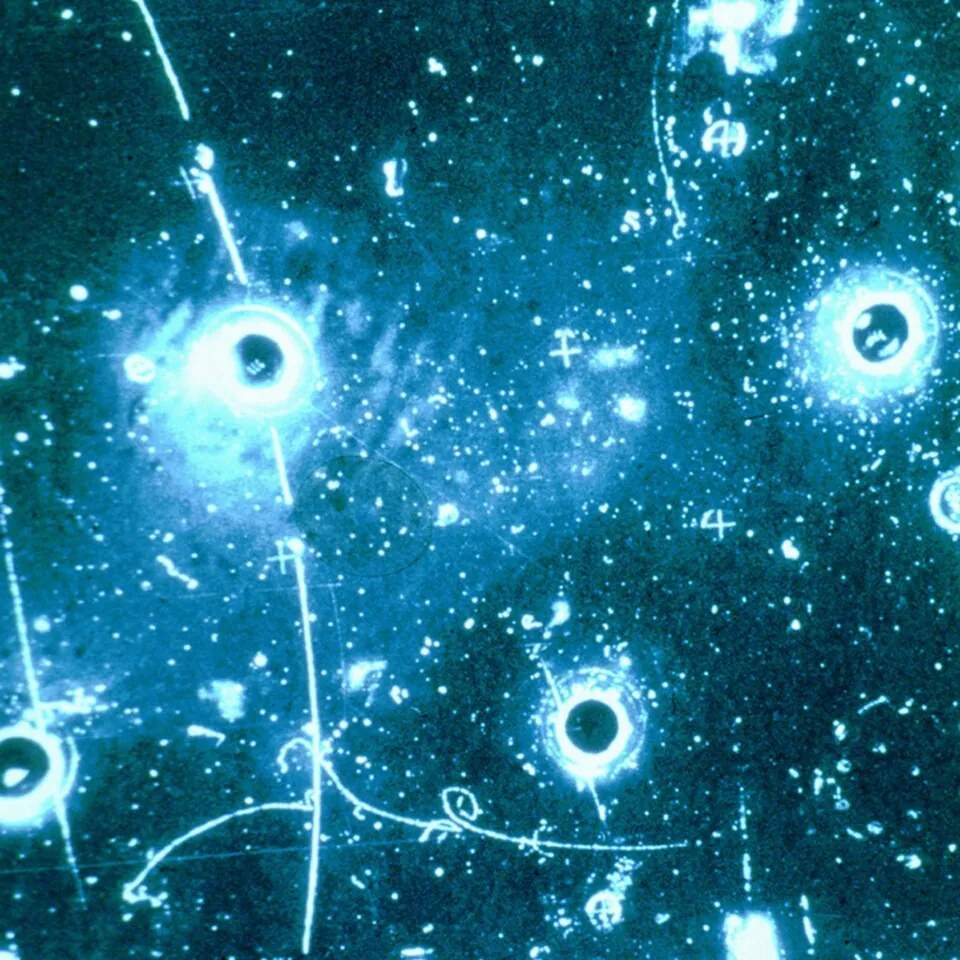
- the neutrino (detected 1956, beside a nuclear reactor), the antiproton (1955, at the Bevatron accelerator), and from the 1950s, dozens of short-lived particles made in accelerators and photographed in bubble chambers.
By the early 1960s over a hundred particles were known, a "particle zoo". A list that long suggested these were not fundamental at all, just as the periodic table's pattern had suggested atoms have an internal structure.
Evidence for quarks
In 1964 Murray Gell-Mann and George Zweig independently noticed that the hadrons (the particles that feel the strong force) fitted patterns that could be explained if they were built from three smaller particles, which Gell-Mann called quarks: up, down and strange, with charges of $+\tfrac23 e$, $-\tfrac13 e$ and $-\tfrac13 e$. The pattern predicted a missing particle, the $\Omega^-$ (three strange quarks), with a particular mass. It was found at Brookhaven later in 1964, with the predicted mass.
Many physicists still thought quarks were just a mathematical device, since nobody had seen a particle with a fractional charge. Direct evidence came from experiments at the Stanford Linear Accelerator Center (SLAC) between 1967 and 1973.
The experiment used the same idea as Geiger and Marsden's, with electrons of up to 20 GeV in place of alpha particles. At these energies, an electron's de Broglie wavelength is about $10^{-16}$ m, a tenth of a proton's diameter, so it can probe inside. If the proton's charge were spread smoothly, electrons would scatter only slightly. Instead, many more than expected scattered through large angles and lost large amounts of energy (the scattering was "deep inelastic"). The results showed point-like charged particles inside the proton, with fractional charges matching quarks. Other experiments also showed that about half the proton's momentum is carried by neutral particles: the gluons.
Estimate the de Broglie wavelength of a 20 GeV electron, and compare it with the size of a proton (about $1.7 \times 10^{-15}$ m across).
At this energy the electron is extremely relativistic, so its momentum is $p \approx E/c$. $E = 20 \times 10^{9} \times 1.602 \times 10^{-19}$ $= 3.20 \times 10^{-9}$ J, so $p = \dfrac{3.20 \times 10^{-9}}{3.00 \times 10^{8}}$ $= 1.07 \times 10^{-17}$ kg m s−1
$\lambda = \dfrac{h}{p} = \dfrac{6.626 \times 10^{-34}}{1.07 \times 10^{-17}} = 6.2 \times 10^{-17}$ m, about 1/30 of the proton's size. Only a wave much smaller than the object can reveal its internal structure, so probing deeper always needs higher energies.
The Standard Model
The Standard Model, developed in the 1960s and 1970s, describes all known matter with 12 fundamental fermions (6 quarks and 6 leptons, each with an antiparticle), the force-carrier bosons, and the Higgs boson.
Quarks come in six flavours in three generations: up and down; charm and strange; top and bottom. They have fractional charge and are the only matter particles that feel the strong force. They are never found alone (confinement): the strong force between quarks does not weaken as they are pulled apart, and the energy put in creates new quark–antiquark pairs instead.
Leptons don't feel the strong force. There are three charged leptons (electron, muon, tau, charge −1) and three neutrinos (electron, muon and tau neutrinos, neutral and almost massless). Leptons appear to be truly fundamental, with no internal structure.
Hadrons are particles made of quarks, held by the strong force. There are two kinds:
- Baryons: three quarks. The proton is uud (charge $\tfrac23 + \tfrac23 - \tfrac13 = +1$); the neutron is udd (charge $\tfrac23 - \tfrac13 - \tfrac13 = 0$). Each quark has baryon number $+\tfrac13$, so a baryon has baryon number +1.
- Mesons: one quark and one antiquark, such as the $\pi^+$ (u$\bar{\text{d}}$) and $K^-$ (s$\bar{\text{u}}$). Mesons have baryon number 0 and are all unstable.
The quarks inside a proton account for only about 1% of its mass. The rest is the energy of the gluon fields and the quarks' motion, through $E = mc^2$.
Fundamental forces
In the Standard Model, forces are transmitted by the exchange of gauge bosons:
| Force | Acts on | Carrier | Relative strength | Range |
|---|---|---|---|---|
| Strong | Quarks and gluons | Gluons (8 types) | 1 | about 10−15 m |
| Electromagnetic | Charged particles | Photon | about 10−2 | Infinite |
| Weak | All quarks and leptons | W+, W−, Z0 bosons | about 10−6 | about 10−18 m |
| Gravity | Everything with mass-energy | Graviton (hypothetical) | about 10−38 | Infinite |
Gravity is not part of the Standard Model: no one has yet combined it with quantum theory. The Higgs boson is not a force carrier; it is the particle of the Higgs field, through which the W and Z bosons, quarks and charged leptons get their masses.
The weak force is the only one that can change one flavour of quark into another. In β⁻ decay, a down quark in a neutron becomes an up quark by emitting a W⁻ boson, which immediately decays into an electron and an electron antineutrino. So udd (neutron) becomes uud (proton).
Conservation laws
Every particle reaction must conserve energy, momentum and charge. Two further numbers are always conserved:
- Baryon number $B$: quarks $+\tfrac13$, antiquarks $-\tfrac13$, so baryons +1, antibaryons −1, mesons and leptons 0.
- Lepton number $L$: +1 for leptons, −1 for antileptons, 0 for everything else, conserved separately for each family (electron, muon, tau).
Checking these tells you whether a proposed reaction can happen. For example, $n \rightarrow p + e^- + \bar{\nu}_e$: charge $0 = +1 - 1 + 0$ ✓; $B$: $1 = 1 + 0 + 0$ ✓; $L_e$: $0 = 0 + 1 - 1$ ✓. Allowed.
- Build u, u, d. Check the readouts: charge +1, baryon number 1, strangeness 0. Which particle is it? Now build u, d, d.
- Build s, s, s. This is the Ω⁻, the particle whose prediction convinced many physicists the quark model was right. What are its charge and strangeness?
- Build u with an anti-d (the d̄ button). What kind of hadron is this, and what is its baryon number?
- Try building two quarks without an antiquark. Why doesn't it make a hadron?
- Switch to Allowed or not? and work through all eight reactions, checking charge, baryon number and lepton number for each before you choose.
Particle accelerators
Accelerators use electric fields to speed up charged particles and magnetic fields to steer and focus them. They serve two roles in testing theories: high energy gives a short de Broglie wavelength to probe small structures (as at SLAC), and high energy can be converted into the mass of new, heavy particles ($E = mc^2$) to test predictions.
- Linear accelerators (linacs) push particles along a straight line through a series of tubes, with alternating voltages timed so the particles are always pulled forward at each gap. SLAC's linac was 3.2 km long. Smaller linacs are used in hospitals to make X-rays for cancer treatment.
- Cyclotrons, invented by Ernest Lawrence in 1932, use a magnetic field to bend particles into a circle so the same accelerating gap is used again and again. As the particles speed up, the radius $r = mv/qB$ grows and they spiral outwards. Cyclotrons are used to make medical isotopes such as fluorine-18.
- Synchrotrons keep particles on a fixed circular path by increasing the magnetic field as their momentum rises. They reach the highest energies. The Australian Synchrotron in Melbourne accelerates electrons to 3 GeV in a 216 m ring and uses the intense X-rays they emit to study materials, proteins and medicines.
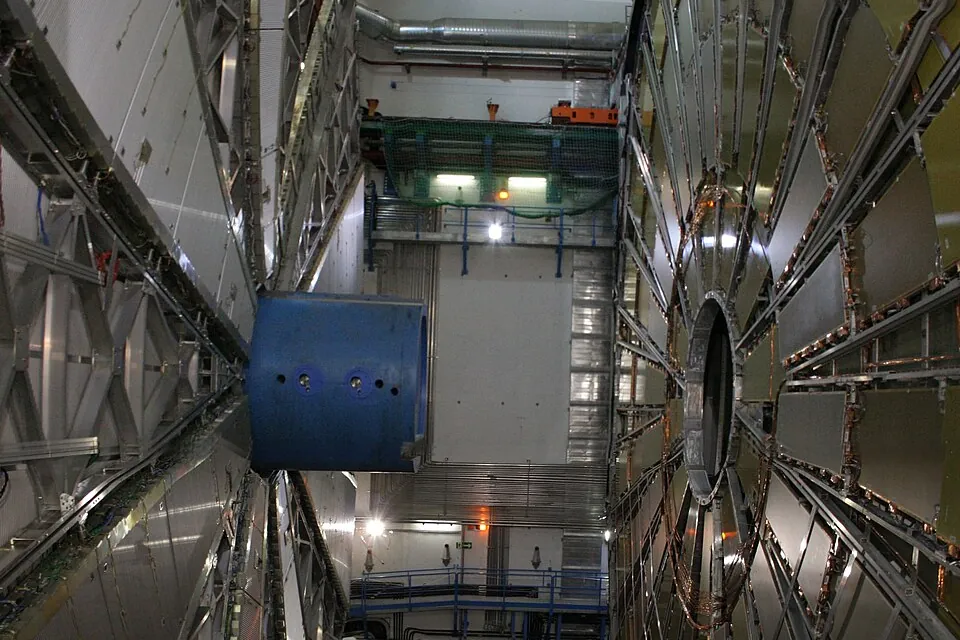
The Large Hadron Collider at CERN is a synchrotron 27 km around, buried about 100 m under the French–Swiss border. Two beams of protons, each at up to 6.8 TeV, travel in opposite directions and collide head-on at four points, where huge detectors record the debris. Colliding beams head-on puts all the energy into making new particles, rather than wasting much of it on the recoil of a fixed target. Australian physicists from the universities of Melbourne, Sydney and Adelaide work on the ATLAS detector.
Accelerators have validated the Standard Model step by step: the W and Z bosons were discovered at CERN in 1983 with exactly the predicted masses; the top quark at Fermilab in 1995; the tau neutrino in 2000; and the Higgs boson at the LHC in 2012. They have also shown what the Standard Model does not explain. It includes no dark matter particle, gives neutrinos no mass (but they do have tiny masses), and doesn't include gravity. Experiments such as SABRE South, in a former gold mine at Stawell in Victoria, are searching for dark matter now.
Test yourself
Which combination of quarks forms a neutron?
udd: charge $\tfrac23 - \tfrac13 - \tfrac13 = 0$.
A particle has the quark composition s$\bar{\text{u}}$. It is a
Quark + antiquark = meson. Charge: s is −1/3, ū is −2/3, total −1 (the K⁻).
The deep inelastic scattering experiments at SLAC showed that
Large-angle scattering of high-energy electrons revealed small, hard charges inside protons: quarks.
Which reaction is NOT allowed?
Charge balances (+1 → 0 + 1), but baryon number goes from 1 to 0 and lepton number from 0 to −1. This is why checking only charge isn't enough.
The main reason for building colliders with ever higher energies is to
Higher energy gives a shorter de Broglie wavelength and more energy to turn into mass.
Label the Feynman diagram of beta-minus decay.
Classify each particle.
Particles made of quarks are called . A baryon contains three quarks; a meson contains a quark and an . The strong force is carried by . The W and Z bosons carry the force. In a synchrotron, the field is increased as the particles gain energy, keeping them on a ring of fixed radius.
Analyse the evidence that protons and neutrons are not fundamental particles, and explain how particle accelerators contributed to this evidence.
From the 1950s, accelerators such as the Bevatron produced dozens of new hadrons, which were photographed in bubble chambers. Turning energy into the mass of new particles ($E = mc^2$) required high-energy collisions. So many "elementary" particles suggested a deeper level of structure. Gell-Mann and Zweig showed that the observed hadrons fitted patterns explained by combinations of three quarks with fractional charges. The model predicted the Ω⁻ (sss) and its mass, and the particle was then found in an accelerator experiment at Brookhaven in 1964, strong evidence the model was more than a classification.
The most direct evidence came from deep inelastic scattering at SLAC from 1967. Its 3.2 km linear accelerator gave electrons energies up to about 20 GeV, so their de Broglie wavelength ($\lambda = h/p \approx 10^{-16}$ m) was much smaller than a proton. If the proton's charge were spread out evenly, the electrons would scatter only through small angles, but many scattered through large angles with large energy losses, showing they were bouncing off small, point-like charged particles inside the proton, as Rutherford's alphas had revealed the nucleus. The data fitted particles of charge $+\tfrac23$ and $-\tfrac13$. Similar results for neutrons (from deuterium targets) showed they also have internal structure. Accelerators were therefore essential: only they could provide the energies needed both to create the new hadrons and to probe distances smaller than a nucleon.