 Coaching Centre
Work, energy and torque in circular motion
Why centripetal force does no work, energy in vertical circles, torque as the turning effect of a force, τ = r⊥F = rF sin θ, and balancing torques.
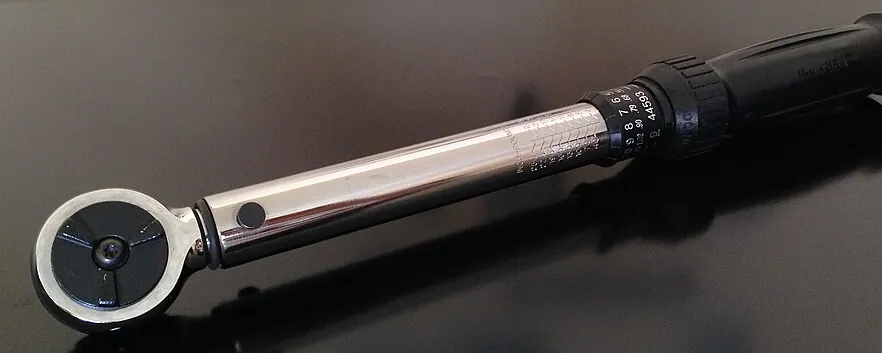
A wheel nut on a car is tightened to about 110 N m. With a short spanner and your hand near the nut, you can heave until you're red in the face and nothing happens. Slide a length of pipe over the handle and it turns with a gentle push. Same nut, same strength. The difference is where you push.
This page has two parts. First, energy: what work does the centripetal force do? Then rotation: what makes something start turning, and how do we measure the turning effect of a force?
Work done in uniform circular motion
Work is $W = Fs\cos\theta$, where $\theta$ is the angle between the force and the displacement. In uniform circular motion, the centripetal force points to the centre while the object moves along the tangent. The angle between them is always 90°, and $\cos90° = 0$, so:
$W_{\text{centripetal}} = 0$
That fits what we see. The centripetal force changes the direction of motion but not the speed, so kinetic energy, $K = \tfrac12 mv^2$, stays constant. By the work–energy theorem, no change in kinetic energy means no net work. A satellite in a circular orbit can go round for years with gravity doing no work on it.
In a horizontal circle, the total energy is constant: $K = \tfrac12 mv^2$, unchanged, and height doesn't change either. If friction or drag acts (a car on a roundabout), the engine must do work against it to keep the speed constant, but that is a tangential force, not the centripetal one.
Energy in a vertical circle
In a vertical circle, gravity has a component along the path, so it does do work: the object slows going up and speeds up coming down. With no friction, mechanical energy is conserved, so between the top and bottom of a loop of radius $r$ (a height difference of $2r$):
$\tfrac12 mv_{\text{bottom}}^2 = \tfrac12 mv_{\text{top}}^2 + mg(2r)$
A roller-coaster car passes the top of a loop of radius 8.0 m at 10 m/s. Ignoring friction, how fast is it moving at the bottom?
Torque: the turning effect of a force
A force makes an object rotate when its line of action doesn't pass through the pivot (the axis of rotation). The turning effect is called torque, $\tau$ (Greek "tau"):
$\tau = r_\perp F = rF\sin\theta$
Here $r$ is the distance from the pivot to where the force acts and $\theta$ is the angle between the force and the line from the pivot. There are two ways to think about the $\sin\theta$:
- only the component of the force perpendicular to the spanner, $F\sin\theta$, turns it; or
- the perpendicular distance from the pivot to the line of action of the force is $r_\perp = r\sin\theta$.
Both give the same answer. Torque is greatest when you push at 90° to the handle and zero when you push straight along it (towards or away from the pivot).
The unit of torque is the newton metre (N m). That's dimensionally the same as the joule, but torque is not energy, so never write J for a torque. Torque has a direction too: clockwise or anticlockwise around the pivot.
A bolt must be tightened to 50 N m using a spanner 0.25 m long. (a) What force is needed at the end of the spanner, pushing at 90°? (b) What force is needed if the push is at 60° to the handle?
Torque explains everyday design: door handles are on the edge away from the hinges; long-handled bolt cutters and wheelbarrows let small forces produce big torques; a bike's gears and pedal cranks are all about torque. And the reason a pipe "cheater bar" helps with a stuck nut is that it increases $r$.
- At the start (0.25 m, 300 N, 90°), the torque is 75.0 N m. Press Turn the nut. How far short of 110 N m are you?
- Move your hand to the end (0.30 m). What is the smallest force that turns the nut? (Theory: $110/0.30 = 367$ N.)
- Turn on Slide a pipe over the handle and push at 0.45 m with 300 N. Now the torque is 135 N m. Then change the angle to 45°. Does it still turn?
- Switch to the bike pedal and find three different combinations of $r$, $F$ and angle that just do it.
Balanced torques
If the clockwise and anticlockwise torques about a pivot are equal, there is no net torque and the object doesn't start to rotate (or keeps rotating at a constant rate). This is the principle behind a seesaw, a crane's counterweight and a set of balance scales.
A 30 kg child sits 2.0 m from the pivot of a seesaw. Where must a 40 kg child sit on the other side to balance it?
Torque is to rotation what force is to straight-line motion. A net force causes a linear acceleration; a net torque causes an angular acceleration. You don't need the rotational version of Newton's second law for the HSC, but you should be able to explain qualitatively that a bigger net torque makes something spin up faster.
Test yourself
A 2.0 kg mass moves in a horizontal circle of radius 0.50 m at 3.0 m/s. The work done by the centripetal force in one revolution is
The force is always perpendicular to the displacement.
A 120 N force is applied at the end of a 0.40 m spanner, at 30° to the handle. The torque is
$\tau = 0.40 \times 120 \times \sin30° = 24$ N m.
Which change would not increase the torque on a door from a push at its handle?
A force along the line through the pivot has $\theta = 0$, so no torque.
A ball on a string swings in a vertical circle of radius 0.60 m. It passes the top at 3.0 m/s. Ignoring friction, its speed at the bottom is closest to
$v^2 = 9.0 + 2(9.8)(1.2) = 32.5$, so $v = 5.7$ m/s.
Label the quantities for torque on a spanner.
Order these pushes on the same 0.30 m spanner from smallest to largest torque.
In uniform circular motion, the centripetal force is to the displacement, so it does no . Torque is the turning effect of a force about a . Its unit is the newton . Torque is greatest when the force is applied as far as possible from the pivot and at to the lever arm.
A mechanic cannot loosen a wheel nut using a 0.30 m wrench. Using the concept of torque, explain two ways the mechanic could loosen the nut without pushing any harder. Include a calculation showing the effect of one of your suggestions if the mechanic pushes with 350 N and the nut needs 130 N m.
The turning effect is the torque $\tau = rF\sin\theta$. With the force at 90° to a 0.30 m wrench, the maximum torque is $0.30 \times 350 = 105$ N m, less than the 130 N m needed. First, the mechanic can increase the lever arm: sliding a pipe over the handle so the push is at least $130/350 = 0.37$ m from the nut gives enough torque with the same force. Second, if they had been pushing at an angle to the handle, pushing at exactly 90° makes $\sin\theta = 1$, so all of the force contributes to the torque.