 Coaching Centre
Binding energy, fission and fusion
Mass defect and binding energy, the binding energy per nucleon curve and why both fission and fusion release energy, calculating the energy released in alpha decay, artificial transmutation, fission and fusion, chain reactions and critical mass, how fission reactors work including Australia's OPAL reactor, and fusion power research.
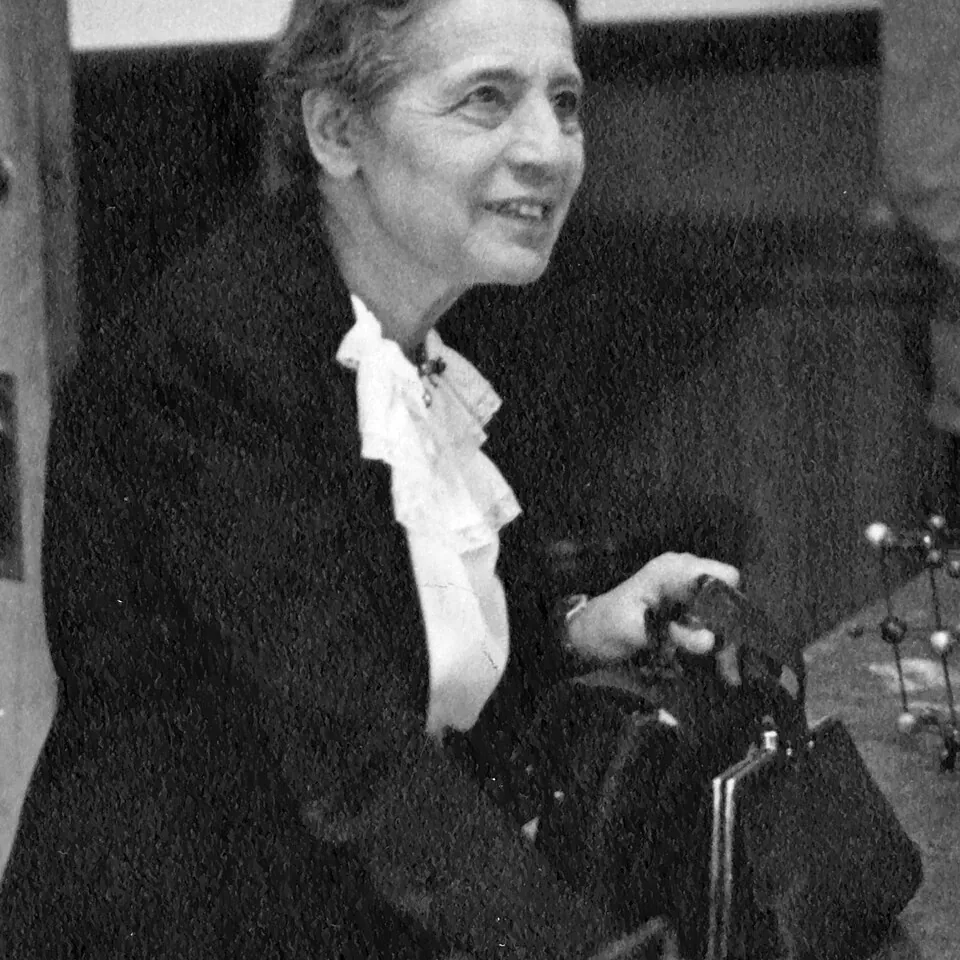
Just before Christmas 1938, the physicist Lise Meitner, who had fled Nazi Germany, went walking in the snow in Sweden with her nephew Otto Frisch. She had a letter from her former colleague Otto Hahn: bombarding uranium with neutrons seemed to make barium, an element half its size. Sitting on a tree trunk, they worked out that the uranium nucleus must have split in two, and calculated from $E = mc^2$ that each split would release about 200 MeV. Frisch named it "fission".
Mass defect and binding energy
A helium-4 nucleus is made of 2 protons and 2 neutrons. Add up their masses separately and you get more than the mass of the nucleus. The difference is the mass defect, $\Delta m$:
$$\Delta m = Zm_p + Nm_n - m_{\text{nucleus}}$$
The missing mass is the mass equivalent of the energy released when the nucleons came together. To pull the nucleus apart into separate nucleons, you would have to put this energy back. That energy is the binding energy:
$$E_B = \Delta m\, c^2$$
Note the sign: a bound nucleus has less mass than its parts, because energy was released when it formed. Binding energy is the energy needed to separate it, not energy stored inside it.
Calculate the binding energy and the binding energy per nucleon of helium-4. Use $m_p = 1.007276$ u, $m_n = 1.008665$ u and the nuclear mass of helium-4, 4.001506 u.
$2(1.007276) + 2(1.008665) = 2.014552 + 2.017330 = 4.031882$ u
$\Delta m = 4.031882 - 4.001506 = 0.030376$ u
$E_B = 0.030376 \times 931.5 = 28.30$ MeV, or in joules: $0.030376 \times 1.661 \times 10^{-27} \times (3.00 \times 10^{8})^2 = 4.54 \times 10^{-12}$ J
$\dfrac{28.30}{4} = 7.07$ MeV per nucleon
If you're given atomic masses (which include electrons), use the mass of a hydrogen-1 atom (1.007825 u) in place of the proton mass. The electrons then cancel. Either way, check which kind of mass the question gives.
The binding energy curve
Binding energy per nucleon measures how tightly a nucleus is held together: the higher it is, the more stable the nucleus.
- It rises steeply for light nuclei, because each nucleon gains more neighbours to bond with. Helium-4 is a spike: unusually tightly bound.
- It peaks at about 8.8 MeV per nucleon around iron-56 and nickel-62, the most tightly bound nuclei.
- It falls slowly for heavy nuclei, because electrostatic repulsion between the many protons grows and acts across the whole nucleus, while the strong force only acts between neighbours. Uranium-235 is about 7.6 MeV per nucleon.
Any nuclear reaction whose products are further up the curve (more tightly bound) releases energy. That is why:
- Fusion of light nuclei releases energy (moving up the steep left side).
- Fission of heavy nuclei releases energy (moving up from the right).
- Nothing releases energy by fusing iron, or splitting it. This is why stellar fusion stops at iron (page 8E).
The energy released in a reaction equals the increase in total binding energy, which equals the decrease in total mass: $E = \Delta m\,c^2$ where $\Delta m = m_{\text{reactants}} - m_{\text{products}}$.
Energy in decays and transmutations
The same method works for every nuclear reaction: total mass before minus total mass after, then convert.
Find the energy released in $^{226}_{\ 88}\text{Ra} \rightarrow {}^{222}_{\ 86}\text{Rn} + {}^4_2\text{He}$. Atomic masses: Ra-226 = 226.025410 u, Rn-222 = 222.017578 u, He-4 = 4.002603 u.
$\Delta m = 226.025410 - (222.017578 + 4.002603) = 226.025410 - 226.020181 = 0.005229$ u
$E = 0.005229 \times 931.5 = 4.87$ MeV. Since momentum is conserved, the light alpha particle carries off most of this as kinetic energy (about 4.78 MeV) and the radon nucleus recoils with the rest.
Induced artificial transmutation is when one element is changed into another by bombarding it. In 1919 Rutherford fired alphas at nitrogen and made oxygen, the first artificial transmutation:
$$^{4}_{2}\text{He} + {}^{14}_{\ 7}\text{N} \rightarrow {}^{17}_{\ 8}\text{O} + {}^{1}_{1}\text{H}$$
Here the products have more mass than the reactants (by 0.00128 u), so the reaction absorbs 1.19 MeV. It only happens if the alpha brings in at least this much kinetic energy (more in practice, to share momentum and overcome repulsion). Today, transmutation by neutrons in reactors and by protons in cyclotrons makes medical isotopes such as molybdenum-99 (parent of technetium-99m) and fluorine-18.
Nuclear fission
When uranium-235 absorbs a slow neutron, it becomes uranium-236 in a highly excited state. The nucleus wobbles, stretches, and splits into two medium-sized fragments plus two or three fast neutrons. One typical split is:
$$^{1}_{0}n + {}^{235}_{\ 92}\text{U} \rightarrow {}^{141}_{\ 56}\text{Ba} + {}^{92}_{36}\text{Kr} + 3\,{}^{1}_{0}n$$
Many other pairs of fragments are possible. The energy appears mainly as kinetic energy of the fragments, which then heats the surrounding material.
Calculate the energy released in the fission reaction above. Masses: n = 1.008665 u, U-235 = 235.043930 u, Ba-141 = 140.914411 u, Kr-92 = 91.926156 u.
$1.008665 + 235.043930 = 236.052595$ u
$140.914411 + 91.926156 + 3(1.008665) = 235.866562$ u
$\Delta m = 0.186033$ u, so $E = 0.186033 \times 931.5 = 173$ MeV $= 2.78 \times 10^{-11}$ J. The radioactive fragments release more energy as they decay, bringing the average total to about 200 MeV per fission.
1 kg of U-235 contains $\dfrac{1000}{235} \times 6.022 \times 10^{23} = 2.56 \times 10^{24}$ nuclei, so it releases about $2.56 \times 10^{24} \times 200 \times 1.602 \times 10^{-13} = 8.2 \times 10^{13}$ J, about 2.5 million times as much as burning 1 kg of coal.
Chain reactions and reactors
Each fission releases about 2.4 neutrons on average. If at least one of them goes on to cause another fission, the process sustains itself: a chain reaction. The multiplication factor $k$ is the average number of new fissions caused by the neutrons from one fission:
- $k \lt 1$: subcritical. The reaction dies away.
- $k = 1$: critical. Steady power, as in a working reactor.
- $k > 1$: supercritical. The number of fissions grows exponentially. In a weapon, $k$ is made as large as possible with highly enriched material.
Neutrons can be lost by escaping through the surface (more important in a small piece of fuel, which is why there is a critical mass), by being captured by uranium-238 or other materials without causing fission, or by absorption in control rods. Natural uranium is only 0.72% uranium-235, and fast neutrons are much more likely to be captured by U-238 than to cause fission. Most reactors therefore use:
- Enriched fuel: uranium with the U-235 increased to 3–5% for power reactors (or about 20% for research reactors like OPAL).
- A moderator (water, heavy water or graphite) whose light nuclei slow fast neutrons by collisions to thermal speeds, where U-235 fission is far more likely.
- Control rods of neutron-absorbing material (boron, cadmium or hafnium), moved in or out to keep $k = 1$.
- A coolant to carry heat away, a steam turbine and generator (in power reactors), and heavy shielding.
- Start with 3% enrichment, core size 5, rods out and water moderator on. Read $k$ (about 1.27). Is the reactor critical, subcritical or supercritical?
- Push the control rods in until $k$ = 1.000. You should need about 35%. Watch the neutron population graph flatten.
- Set the rods back to 0 and drop to natural uranium (0.7%). Can you make it critical with ordinary water as the moderator, even at the largest core size?
- Go back to 3% and turn the moderator off. What happens to $k$, and why?
- With no moderator, raise the enrichment to 90%. Why is this combination used in weapons and not in power reactors?
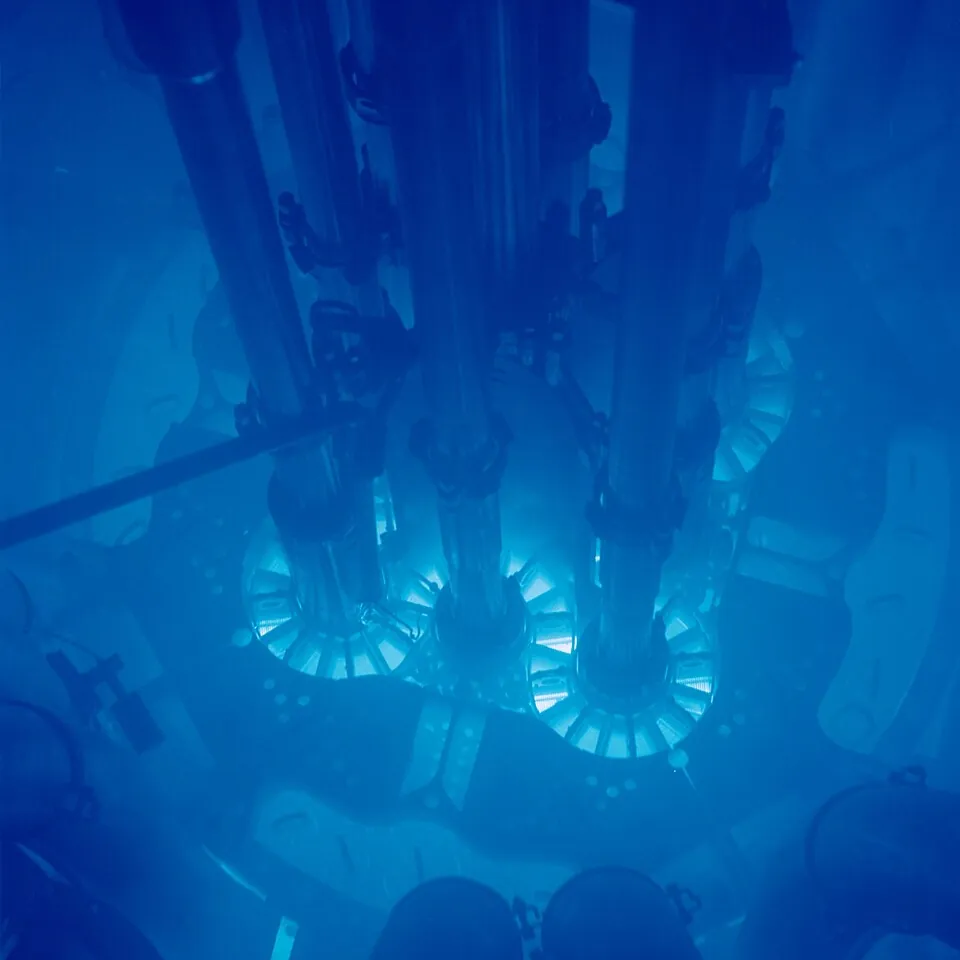
Australia has no nuclear power stations, but ANSTO's OPAL research reactor at Lucas Heights in Sydney (20 MW, running since 2007) uses low-enriched uranium fuel cooled and moderated by water and surrounded by heavy water. It produces neutrons for materials research and transmutes targets to make medical isotopes, including molybdenum-99, the source of the technetium-99m used in thousands of Australian medical scans every week. The blue glow seen in reactor pools is Cherenkov radiation, given out by electrons travelling faster than light does in water.
Nuclear fusion
The reaction easiest to achieve on Earth fuses deuterium and tritium, two isotopes of hydrogen:
$$^{2}_{1}\text{H} + {}^{3}_{1}\text{H} \rightarrow {}^{4}_{2}\text{He} + {}^{1}_{0}n$$
Calculate the energy released per D–T fusion and per kilogram of fuel. Masses: $^2$H = 2.014102 u, $^3$H = 3.016049 u, $^4$He = 4.002603 u, n = 1.008665 u.
$\Delta m = (2.014102 + 3.016049) - (4.002603 + 1.008665) = 5.030151 - 5.011268 = 0.018883$ u
$E = 0.018883 \times 931.5 = 17.6$ MeV $= 2.82 \times 10^{-12}$ J
One reaction uses $5.030 \times 1.661 \times 10^{-27} = 8.355 \times 10^{-27}$ kg of fuel, so 1 kg gives $\dfrac{2.82 \times 10^{-12}}{8.355 \times 10^{-27}} = 3.4 \times 10^{14}$ J, about four times as much as fission per kilogram.
Each fusion releases much less energy than a fission (17.6 MeV against about 200 MeV), but per nucleon it is far more (3.5 MeV against 0.85 MeV), because the left side of the binding energy curve is so steep.
The challenge is getting nuclei close enough: they must be heated to over 100 million K (hotter than the Sun's core, which makes up for its low rate with enormous size and density) and held long enough at high density. Tokamaks confine the plasma with magnetic fields; the international ITER tokamak being built in France aims to produce ten times more fusion power than the heating power put in. In December 2022 the US National Ignition Facility used lasers to produce more fusion energy from a fuel pellet than the laser energy delivered to it, for the first time. Practical fusion power stations are still decades away. Advantages would include abundant fuel (deuterium from seawater; tritium bred from lithium), no long-lived fission products and no possibility of a runaway chain reaction.
Test yourself
The mass defect of a nucleus is 0.0400 u. Its binding energy is
$0.0400 \times 931.5 = 37.3$ MeV.
Which nucleus has the highest binding energy per nucleon?
The curve peaks near iron-56 (about 8.8 MeV per nucleon).
In a nuclear reactor, the main purpose of the moderator is to
Slow (thermal) neutrons are far more likely to be absorbed by U-235 and cause fission.
Complete the equation: $^{1}_{0}n + {}^{235}_{\ 92}\text{U} \rightarrow {}^{144}_{\ 56}\text{Ba} + {}^{89}_{36}\text{Kr} + x\,{}^{1}_{0}n$. The value of x is
A: 1 + 235 = 236 = 144 + 89 + x, so x = 3. Z: 92 = 56 + 36 ✓.
Rutherford's reaction $^4\text{He} + {}^{14}\text{N} \rightarrow {}^{17}\text{O} + {}^1\text{H}$ has products with more mass than the reactants. This means
Mass-energy is conserved: the extra rest mass comes from the alpha's kinetic energy.
Label the parts of the reactor.
Fission, fusion or both?
The difference between the mass of the separate nucleons and the mass of the nucleus is the mass . One atomic mass unit is equivalent to MeV. A chain reaction is steady when the multiplication factor k equals . Control rods are used to neutrons. Energy is released in a nuclear reaction when the total binding energy .
Using the binding energy per nucleon curve, account for the release of energy in both nuclear fission and nuclear fusion. Support your answer with a calculation of the energy released in the reaction $^{2}_{1}\text{H} + {}^{2}_{1}\text{H} \rightarrow {}^{3}_{2}\text{He} + {}^{1}_{0}n$. (Masses: $^2$H 2.014102 u; $^3$He 3.016029 u; n 1.008665 u.)
The binding energy of a nucleus is the energy needed to separate it into individual nucleons; it equals the mass defect times $c^2$. Binding energy per nucleon is a measure of stability. It rises steeply for light nuclei, as each nucleon gains more neighbours attracted by the short-range strong force; peaks at about 8.8 MeV per nucleon near iron-56; and falls gradually for heavy nuclei, because the long-range electrostatic repulsion between protons grows faster than the strong-force attraction.
In fission, a heavy nucleus such as uranium-235 (about 7.6 MeV per nucleon) splits into two medium nuclei (about 8.4–8.5 MeV per nucleon). In fusion, light nuclei such as deuterium (about 1.1 MeV per nucleon) join to form a more tightly bound nucleus such as helium. In both cases the products lie higher on the curve, so the total binding energy increases. Correspondingly the total mass of the products is less than that of the reactants, and the mass difference is released as kinetic energy of the products and as radiation, $E = \Delta m c^2$.
Calculation: $\Delta m = 2(2.014102) - (3.016029 + 1.008665) = 4.028204 - 4.024694 = 0.003510$ u. $E = 0.003510 \times 931.5 = 3.27$ MeV $= 5.24 \times 10^{-13}$ J released.