 Coaching Centre
Ionic and metallic bonding
Bonding as electrostatic attraction, forming ions and ionic lattices, electron-dot diagrams for ionic compounds, writing formulae and naming ionic compounds including polyatomic ions, metallic bonding and alloys, the properties these structures produce, and electronegativity difference as a guide to bond type.
A grain of table salt and a copper wire are both solids at room temperature, both made of positive and negative charges held together, and both have high melting points. Yet hit the salt crystal with a hammer and it shatters; hit the copper and it flattens. Dissolve the salt and the solution conducts; the solid copper conducts already. The differences come down to where the electrons are.
Why atoms bond
Every chemical bond is an electrostatic attraction between positive and negative charges. Atoms bond because the bonded arrangement has lower energy than the separate atoms. For main-group elements, the lower-energy arrangement often gives each atom a noble gas configuration: eight electrons in its outer shell (two for hydrogen). There are three ways to get there, depending on the atoms involved:
- Ionic bonding: a metal transfers electrons to a non-metal, and the resulting ions attract.
- Metallic bonding: metal atoms release outer electrons into a shared sea that holds the cations together.
- Covalent bonding: non-metal atoms share pairs of electrons (lesson 1H).
Ionic bonding
Metals have low ionisation energies and lose electrons easily; non-metals have high electronegativities and gain them. When sodium meets chlorine, sodium's 3s electron transfers to chlorine's 3p subshell. Na⁺ now has the configuration of neon and Cl⁻ that of argon.
An electron-dot (Lewis) diagram shows only valence electrons. For ionic compounds, show the transfer, then the ions in square brackets with their charges:
The ions don't pair off into molecules. Each ion attracts every oppositely charged ion around it, so they pack into a three-dimensional ionic lattice. In sodium chloride each Na⁺ is surrounded by six Cl⁻ and each Cl⁻ by six Na⁺. The formula NaCl is a formula unit: the simplest ratio of ions, not a molecule.
Formulae and names of ionic compounds
An ionic compound is electrically neutral, so the total positive charge equals the total negative charge. Main-group ions take a charge set by their group: group 1 → +1, group 2 → +2, aluminium → +3, group 15 → −3, group 16 → −2, group 17 → −1. Many compounds contain polyatomic ions, groups of covalently bonded atoms that carry an overall charge.
| +1 | −1 | −2 | −3 |
|---|---|---|---|
| ammonium NH₄⁺ | hydroxide OH⁻ | sulfate SO₄²⁻ | phosphate PO₄³⁻ |
| nitrate NO₃⁻ | carbonate CO₃²⁻ | ||
| hydrogen carbonate HCO₃⁻ | sulfite SO₃²⁻ | ||
| ethanoate (acetate) CH₃COO⁻ | dichromate Cr₂O₇²⁻ | ||
| permanganate MnO₄⁻ |
Naming: the cation comes first, then the anion. Simple anions end in -ide (chloride, oxide, sulfide, nitride). Transition metals that form more than one ion show the charge in Roman numerals: iron(II) chloride is FeCl₂, iron(III) chloride is FeCl₃. Common examples are Cu⁺ and Cu²⁺, Fe²⁺ and Fe³⁺; Ag⁺ and Zn²⁺ are usually named without numerals because they have only one common charge.
Write formulae for (a) aluminium oxide, (b) calcium nitrate, (c) iron(III) sulfate, and name (d) CuCl₂ and (e) (NH₄)₃PO₄.
(a) Al³⁺ and O²⁻: lowest common multiple of 3 and 2 is 6, so 2 Al³⁺ (+6) and 3 O²⁻ (−6): Al₂O₃.
(b) Ca²⁺ and NO₃⁻: two nitrates balance one calcium, and brackets keep the polyatomic ion together: Ca(NO₃)₂.
(c) Fe³⁺ and SO₄²⁻: 2 × (+3) = +6 and 3 × (−2) = −6: Fe₂(SO₄)₃.
(d) Two Cl⁻ means copper is +2: copper(II) chloride. (e) Ammonium phosphate.
Properties of ionic compounds
- High melting and boiling points (NaCl melts at 801 °C; MgO at 2852 °C). Melting means overcoming strong attractions between many ions. Smaller, more highly charged ions attract more strongly, which is why MgO (2+ and 2−) melts far higher than NaCl.
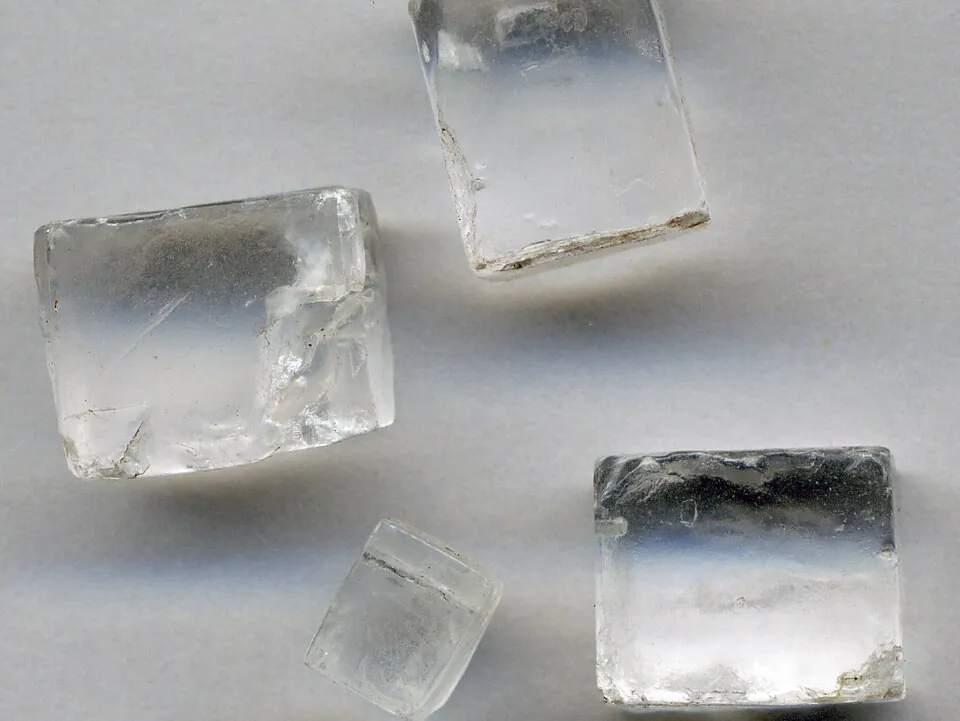
- Hard but brittle. A sharp blow shifts one layer of ions by half a spacing, lining up like charges, which repel and split the crystal.
- Conduct electricity only when molten or dissolved. In the solid the ions are locked in place; melting or dissolving frees them to move. Electrons do not carry the current: ions do.
- Many dissolve in water, a polar solvent that attracts the ions out of the lattice, though some (such as CaCO₃ and BaSO₄) are insoluble.
Metallic bonding
Metal atoms have few valence electrons, held weakly. In a metal, these electrons are delocalised: they are not attached to any one atom but move freely through a lattice of metal cations. Metallic bonding is the electrostatic attraction between the cations and this sea of delocalised electrons.
- Electrical conductivity in the solid: delocalised electrons drift towards the positive terminal when a voltage is applied.
- Thermal conductivity: mobile electrons carry kinetic energy quickly through the metal.
- Malleable and ductile: bonding is non-directional, so layers of cations can slide over each other while the electron sea keeps holding them together.
- Lustre: delocalised electrons absorb and re-emit light.
- Melting points vary widely, from mercury (−39 °C) to tungsten (3422 °C). Across period 3, Na (98 °C) < Mg (650 °C) < Al (660 °C): more delocalised electrons per atom and a higher cation charge strengthen the bonding.
Alloys are mixtures of a metal with other elements. Atoms of a different size disrupt the regular layers, making it harder for them to slide, so alloys are usually harder and stronger than the pure metal: steel (iron with carbon), bronze (copper with tin), and the 18-carat gold in jewellery (75% gold with copper and silver).
Ionic, covalent or metallic? Using electronegativity
The type of bond between two elements depends on how strongly each attracts electrons. A large electronegativity difference (ΔEN) means one atom takes the electron: ionic. Two atoms that both attract electrons strongly share them: covalent. Two atoms that both hold electrons weakly let them delocalise: metallic. The boundaries are not sharp.
Use electronegativities (K 0.82, Cl 3.16, C 2.55, H 2.20, O 3.44) to classify the bonds in KCl, CH₄ and the O–H bond in water.
KCl: ΔEN = 3.16 − 0.82 = 2.34: ionic.
C–H: ΔEN = 2.55 − 2.20 = 0.35: essentially non-polar covalent.
O–H: ΔEN = 3.44 − 2.20 = 1.24: polar covalent, with the oxygen end slightly negative.
- Start on NaCl (ΔEN 2.23): ionic. Now try MgO and CsF. Which sits highest in the ionic region?
- Select Na, then Cl₂. Both have ΔEN = 0. What makes one metallic and the other covalent?
- Try AlCl₃ (ΔEN 1.55) and Al₂O₃ (ΔEN 1.83). Aluminium chloride sublimes at 180 °C. Does the triangle agree that it is not a typical ionic solid?
- Choose Si and GaAs. Why does electronegativity alone struggle to classify semiconductors?
- Use the sliders to make your own pairs. Find a pair with ΔEN close to 1.8 and look up what kind of solid it forms.
Test yourself
What is the formula of ammonium sulfate?
NH₄⁺ and SO₄²⁻: two ammonium ions per sulfate.
Solid potassium iodide does not conduct electricity, but molten potassium iodide does. This is because
Current in an ionic substance is carried by mobile ions.
Which property of metals is best explained by the non-directional nature of metallic bonding?
Layers can slide without breaking the bonding, because the electron sea holds cations in any position.
Magnesium oxide (mp 2852 °C) melts at a much higher temperature than sodium chloride (mp 801 °C) mainly because
Attraction increases with ion charge and decreases with distance.
The name of Fe₂O₃ is
Three O²⁻ (−6) balanced by two Fe, so each Fe is +3.
Label the bonding continuum.
Which kind of substance has each property?
In ionic bonding, metal atoms transfer electrons to non-metal atoms to form and anions. The simplest ratio of ions in an ionic compound is called a . A group of atoms that carries a charge, such as NO₃⁻, is a ion. In a metal, valence electrons are . A mixture of a metal with other elements is an .
Calcium reacts with chlorine to form calcium chloride. (a) Draw electron-dot diagrams to show how the bonding forms. (b) Write the formula. (c) Compare the electrical conductivity and malleability of calcium metal with those of solid calcium chloride, explaining each in terms of structure and bonding.
(a) Ca has two valence electrons (Ca:) and each Cl has seven. Calcium transfers one electron to each of two chlorine atoms, giving Ca²⁺ and two chloride ions, each drawn as [:Cl:]⁻ with eight dots inside square brackets.
(b) CaCl₂.
(c) Conductivity. Calcium metal is a lattice of Ca²⁺ ions in a sea of delocalised electrons; when a voltage is applied the electrons move, so it conducts as a solid. In solid CaCl₂ the ions are held in fixed positions and there are no free electrons, so it does not conduct; it conducts only when molten or dissolved, when the ions can move.
Malleability. Metallic bonding is non-directional: layers of Ca²⁺ can slide over one another while the electron sea still holds them together, so calcium bends and flattens. In CaCl₂, shifting a layer brings ions of the same charge next to each other; they repel and the crystal shatters, so it is brittle.