 Coaching Centre
The mole and Avogadro’s number
Relative atomic, molecular and formula mass, the 2019 SI definition of the mole and Avogadro's constant, molar mass, and converting between mass, moles and numbers of particles and atoms with n = m/M and N = n × NA.
A single drop of water contains about 1.7 × 10²¹ molecules. No one can count that many things one by one, so chemists count the way a bank counts coins: by weighing. If you know the mass of one particle, the mass of a sample tells you how many particles it contains. The mole is the unit that makes this work.
Relative atomic mass
Atoms are far too light to weigh in grams conveniently (a carbon-12 atom is 1.99 × 10⁻²³ g), so their masses are compared on a relative scale on which one atom of carbon-12 has a mass of exactly 12. The relative atomic mass, Aᵣ, of an element is the weighted average mass of its naturally occurring isotopes on this scale. It has no units.
Natural chlorine is 75.78% chlorine-35 (isotopic mass 34.969) and 24.22% chlorine-37 (isotopic mass 36.966).
$A_r = 0.7578 \times 34.969 + 0.2422 \times 36.966 = 35.45$
No single chlorine atom has a mass of 35.45; it is the average. This is why the values on the periodic table on your data sheet are not whole numbers.
Add up the relative atomic masses in a formula to get the relative molecular mass (for molecules, such as H₂O: 2 × 1.008 + 16.00 = 18.02) or the relative formula mass (for ionic compounds, which have no molecules, such as NaCl: 22.99 + 35.45 = 58.44). For a hydrate, include the water: CuSO₄·5H₂O is 159.62 + 5 × 18.02 = 249.7.
The mole and Avogadro's constant
The mole (symbol mol) is the SI unit for amount of substance. Since 20 May 2019 it has been defined by a fixed number:
1 mol contains exactly 6.022 140 76 × 10²³ specified entities
This number of particles per mole is the Avogadro constant, $N_A = 6.022 \times 10^{23}\ \text{mol}^{-1}$ (the value on the HSC data sheet). The entities must always be stated: atoms, molecules, ions, formula units or electrons. "One mole of oxygen" is ambiguous: 1 mol of O₂ molecules contains 2 mol of O atoms.
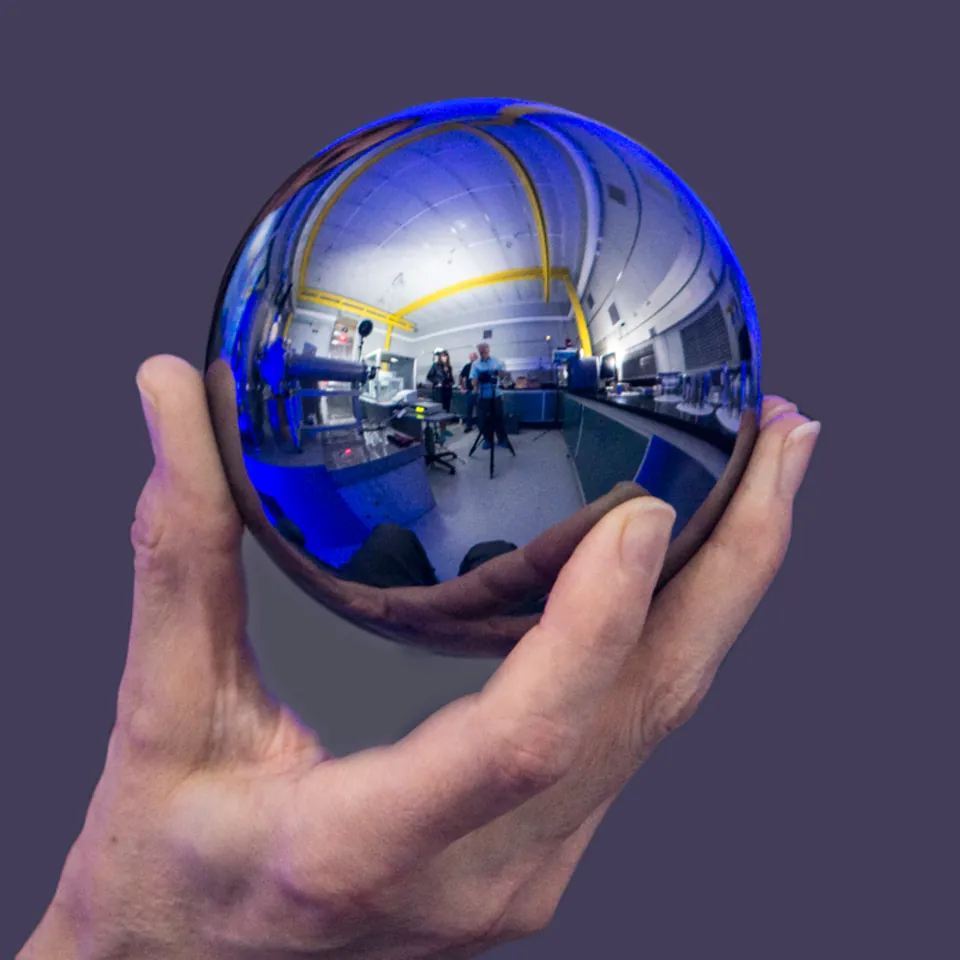
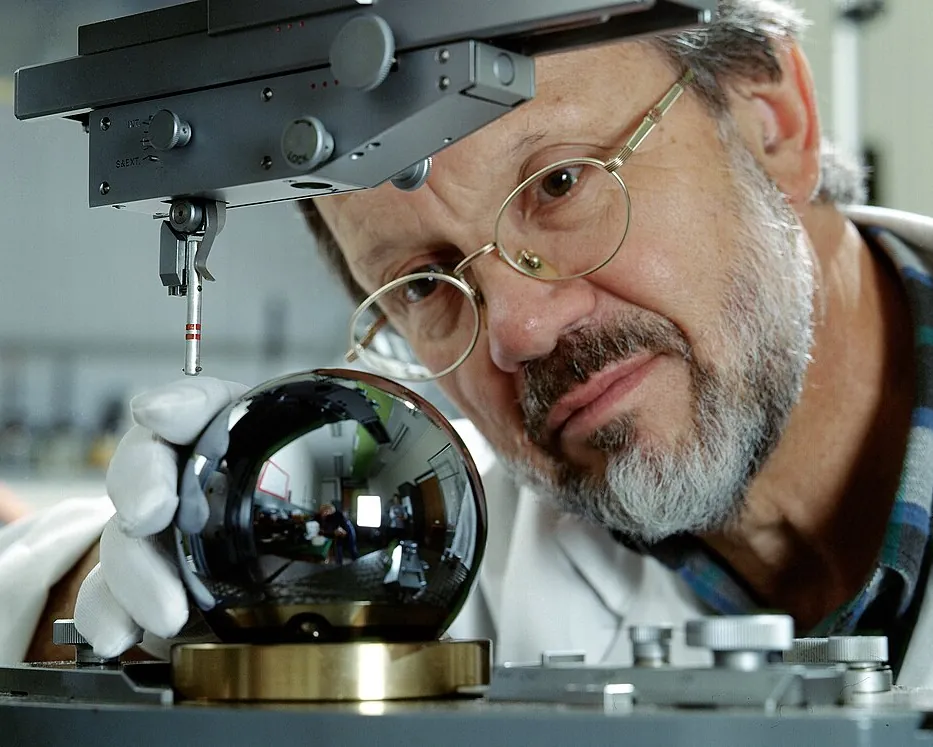
Before 2019 the mole was defined as the number of atoms in exactly 12 g of carbon-12, and NA had to be measured. The value that was finally fixed came largely from counting the atoms in nearly perfect spheres of silicon-28. The spheres were polished at CSIRO in Sydney, where optician Achim Leistner made them so round that if one were scaled up to the size of the Earth, its highest mountain would be only a few metres tall.
Molar mass
The scale was chosen so that one mole of particles has a mass in grams numerically equal to the relative mass. The molar mass, M, is the mass of one mole, in g mol⁻¹:
- M(C) = 12.01 g mol⁻¹: 12.01 g of carbon contains 6.022 × 10²³ atoms.
- M(H₂O) = 18.02 g mol⁻¹: 18.02 g of water (about 18 mL) contains 6.022 × 10²³ molecules.
- M(NaCl) = 58.44 g mol⁻¹: 58.44 g contains 6.022 × 10²³ formula units, which is 2 × 6.022 × 10²³ ions.
The two key relationships
$$n = \frac{m}{M} \qquad\qquad N = n \times N_A$$
where n is the amount in mol, m the mass in g, M the molar mass in g mol⁻¹, and N the number of particles. Rearrange as m = nM and n = N ÷ NA.
How many molecules, and how many atoms, are in 5.00 g of water?
$n = \dfrac{m}{M} = \dfrac{5.00}{18.02} = 0.2775\ \text{mol}$
$N = nN_A = 0.2775 \times 6.022\times10^{23} = 1.67\times10^{23}$ molecules
Each molecule has 3 atoms: $3 \times 1.671\times10^{23} = 5.01\times10^{23}$ atoms.
What is the mass of 3.0 × 10²² atoms of copper?
$n = \dfrac{N}{N_A} = \dfrac{3.0\times10^{22}}{6.022\times10^{23}} = 0.0498\ \text{mol}$
$m = nM = 0.0498 \times 63.55 = 3.2\ \text{g}$ (2 significant figures)
How many oxygen atoms are in 10.0 g of copper(II) sulfate pentahydrate, CuSO₄·5H₂O?
n(CuSO₄·5H₂O) = 10.0 ÷ 249.7 = 0.04005 mol
Each formula unit contains 4 + 5 = 9 O atoms, so n(O) = 9 × 0.04005 = 0.3604 mol.
N(O) = 0.3604 × 6.022 × 10²³ = 2.17 × 10²³ oxygen atoms.
What is the mass of one gold atom?
$\text{mass} = \dfrac{M}{N_A} = \dfrac{197.0\ \text{g mol}^{-1}}{6.022\times10^{23}\ \text{mol}^{-1}} = 3.271\times10^{-22}\ \text{g}$
- Choose H₂O and set the mass to 18.02 g. Check you get 1.000 mol, 6.022 × 10²³ molecules and 1.807 × 10²⁴ atoms.
- Choose C₆H₁₂O₆, switch to Set the moles and choose 1.000 mol. Why does one mole of glucose contain 1.445 × 10²⁵ atoms?
- Choose Fe, switch to particles and set 3.011 × 10²³ atoms. What mass is that? (Answer: about 27.9 g, half a mole.)
- Compare the sample volumes for 1.000 mol of Fe, C and NaCl. Same number of particles, very different volumes: why?
Test yourself
What is the molar mass of calcium nitrate, Ca(NO₃)₂?
40.08 + 2 × (14.01 + 3 × 16.00) = 40.08 + 124.02 = 164.10 g mol⁻¹.
Which sample contains the greatest number of atoms?
Moles of atoms: 1.0; 0.50 × 4 = 2.0; 0.40 × 9 = 3.6; 0.80 × 3 = 2.4.
How many chloride ions are in 2.00 g of calcium chloride, CaCl₂ (M = 110.98 g mol⁻¹)?
n(CaCl₂) = 0.01802 mol; n(Cl⁻) = 0.03604 mol; × 6.022 × 10²³ = 2.17 × 10²².
Since 2019, which statement about the Avogadro constant is correct?
The 2019 SI redefinition fixed NA exactly; 12 g of C-12 is now only very nearly one mole.
Element X has two isotopes: ⁶³X (69.2%, mass 62.93) and ⁶⁵X (30.8%, mass 64.93). What is the relative atomic mass of X?
0.692 × 62.93 + 0.308 × 64.93 = 43.55 + 20.00 = 63.55 (it's copper).
Order these samples from fewest to most molecules.
Label the quantities that convert through moles.
The relative atomic mass of an element is the average of its isotopic masses. One mole contains entities. Molar mass is measured in . Ionic compounds are counted in . To convert moles to a number of particles, by the Avogadro constant.
A daily vitamin tablet contains 18.0 mg of iron as iron(II) fumarate, FeC₄H₂O₄ (M = 169.9 g mol⁻¹). Calculate (a) the mass of iron(II) fumarate in the tablet and (b) the number of iron(II) ions it provides.
(a) n(Fe) = m ÷ M = 0.0180 g ÷ 55.85 g mol⁻¹ = 3.223 × 10⁻⁴ mol. Each formula unit contains one Fe, so n(FeC₄H₂O₄) = 3.223 × 10⁻⁴ mol. m = nM = 3.223 × 10⁻⁴ × 169.9 = 0.0548 g = 54.8 mg.
(b) N(Fe²⁺) = nNA = 3.223 × 10⁻⁴ × 6.022 × 10²³ = 1.94 × 10²⁰ ions.