 Coaching Centre
Heat of combustion
Molar heat of combustion, measuring it with a spirit burner and with a bomb calorimeter, calibrating a calorimeter, heat of combustion per gram, and comparing fuels and foods.
The nutrition panel on a muesli bar says 1580 kJ per 100 g. Nobody fed that bar to a person to find out. Someone burned a sample in pure oxygen inside a sealed steel container and measured how much a tank of water warmed up. The same instrument checks the energy content of the coal leaving Newcastle and the jet fuel at Sydney airport.
Molar heat of combustion
The molar heat of combustion, $\Delta_c H$, is the enthalpy change when one mole of a substance burns completely in excess oxygen, with the products in their standard states (so water as a liquid at 25 °C). Combustion is always exothermic, so $\Delta_c H$ is always negative. Many tables, including the HSC data sheet's, list the heat released as a positive number; when you use one in a calculation, put the minus sign back.
$$\text{C}_2\text{H}_5\text{OH}(l) + 3\text{O}_2(g) \rightarrow 2\text{CO}_2(g) + 3\text{H}_2\text{O}(l) \qquad \Delta_c H = -1367 \text{ kJ mol}^{-1}$$
"Complete" matters. With too little oxygen, carbon fuels also form carbon monoxide and soot (carbon), and less energy is released, because those products haven't been fully oxidised.
Measuring it in the school lab
The simple method burns the fuel in a spirit burner under a metal can of water and uses $q = mc\Delta T$ for the water. The alcohol version, comparing ethanol, propan-1-ol and butan-1-ol, is done in detail in Year 12 Module 7; here is the calculation.
Burning 0.92 g of ethanol (M = 46.07 g mol⁻¹) heats 200 g of water from 20.5 °C to 37.0 °C. Calculate ΔcH and compare with the data value of −1367 kJ mol⁻¹.
The bomb calorimeter
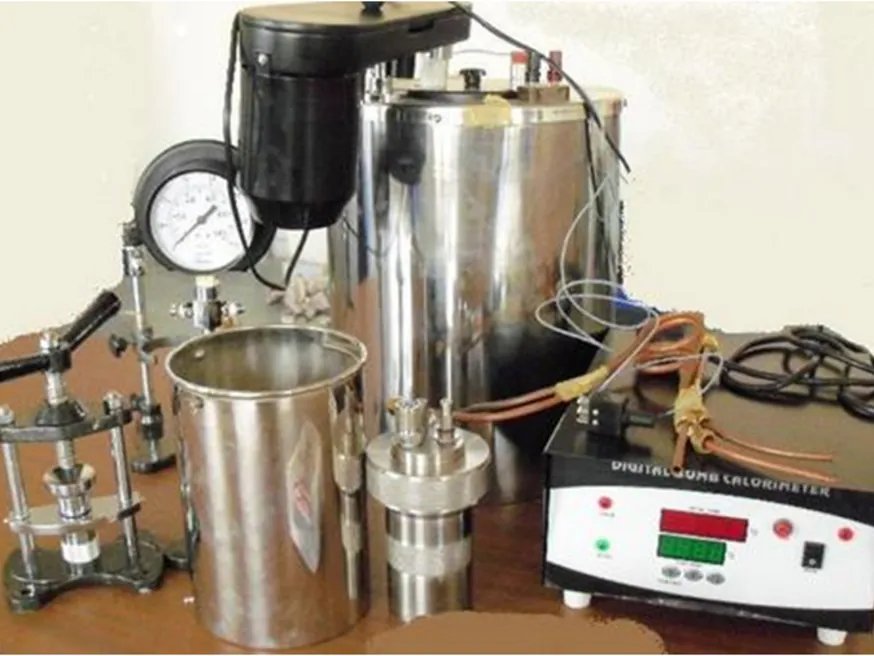
Accurate heats of combustion come from a bomb calorimeter. A weighed sample sits in a small crucible inside a sealed stainless-steel "bomb" filled with oxygen at about 25 times atmospheric pressure. The bomb sits in a measured mass of water inside an insulated jacket. An electric current through a fine wire ignites the sample, and a precise thermometer records the rise in water temperature.
Because the heat warms the water and the steel bomb, stirrer and thermometer, you can't just use $q = mc\Delta T$ for the water. Instead the whole instrument is calibrated: a known amount of heat is released inside it and the temperature rise is measured. This gives the calorimeter constant (heat capacity of the whole calorimeter), $C$, in kJ K⁻¹:
$$C = \frac{q_\text{known}}{\Delta T} \qquad\text{then}\qquad q = C\Delta T$$
The known heat comes from burning a standard substance (benzoic acid, which releases 26.43 kJ g⁻¹) or from an electric heater, where $q = VIt$.
Burning 1.000 g of benzoic acid in a bomb calorimeter raises the temperature by 2.541 °C. Then 1.000 g of ethanol raises it by 2.853 °C. Calculate ΔcH(ethanol).
- Press 2. Burn a sample and Fire before calibrating. Why can't you get ΔcH from ΔT alone?
- Calibrate with Benzoic acid: ΔT = 2.541 °C, so C = 10.40 kJ K⁻¹. Calibrate again with the Heater. Do the two methods agree?
- Burn 1.00 g of Ethanol (ΔT = 2.853 °C) and check that ΔcH comes out within 1 kJ of the data value, −1367 kJ mol⁻¹.
- Burn 1.00 g each of Octane and Glucose. Which gives more energy per gram, and why do fuels with more C–H bonds per gram release more?
Energy per gram: comparing fuels and foods
For choosing a fuel, the heat released per gram (or per litre) often matters more than per mole. Divide ΔcH by the molar mass:
$$\text{heat per gram} = \frac{|\Delta_c H|}{M}$$
The pattern: the more of a fuel's mass is hydrogen and carbon that is not yet bonded to oxygen, the more energy it releases per gram. Ethanol and glucose are already partly oxidised (they contain O atoms), so they release less than octane. Hydrogen releases the most of all per gram, which is why it powers rockets and why Australia is investing in hydrogen as an export fuel. Food energy works the same way: fats (about 37 kJ g⁻¹) are less oxidised than carbohydrates (about 17 kJ g⁻¹).
Octane, C₈H₁₈ (M = 114.2 g mol⁻¹), has ΔcH = −5470 kJ mol⁻¹. How much heat is released by burning 1.00 kg of octane?
| Fuel | ΔcH (kJ mol⁻¹) | M (g mol⁻¹) | kJ g⁻¹ |
|---|---|---|---|
| Hydrogen, H₂ | −286 | 2.016 | 141.8 |
| Methane, CH₄ | −890 | 16.04 | 55.5 |
| Octane, C₈H₁₈ | −5470 | 114.2 | 47.9 |
| Ethanol, C₂H₅OH | −1367 | 46.07 | 29.7 |
| Methanol, CH₃OH | −726 | 32.04 | 22.7 |
| Glucose, C₆H₁₂O₆ | −2803 | 180.2 | 15.6 |
Test yourself
A bomb calorimeter has C = 8.75 kJ K⁻¹. Burning 0.500 g of glucose (M = 180.2 g mol⁻¹) raises its temperature by 0.889 K. What is ΔcH of glucose?
q = 8.75 × 0.889 = 7.78 kJ; n = 0.500 ÷ 180.2 = 0.002775 mol; ΔcH = −7.78 ÷ 0.002775 = −2803 kJ mol⁻¹.
An electric heater supplying 12.0 V and 4.00 A for 150 s raises the temperature of a calorimeter by 1.20 K. The calorimeter constant is
q = VIt = 12.0 × 4.00 × 150 = 7200 J = 7.20 kJ; C = 7.20 ÷ 1.20 = 6.00 kJ K⁻¹.
Why does a spirit burner experiment give a much smaller |ΔcH| than a bomb calorimeter?
Heat loss to the surroundings and incomplete combustion both mean less heat reaches the water than the fuel released.
Which fuel releases the most energy per gram?
Methane 55.5 kJ g⁻¹, octane 47.9, ethanol 29.7, glucose 15.6. Methane has the highest proportion of hydrogen by mass.
Label the parts of the bomb calorimeter.
Which method does each statement describe?
The molar heat of combustion is the heat released when one of a substance burns completely in . Its sign is always . A bomb calorimeter is calibrated to find its , C, so that q = CΔT.
A bomb calorimeter was calibrated by burning 0.800 g of benzoic acid (26.43 kJ g⁻¹), which raised the temperature by 2.12 K. Then 0.500 g of methanol (M = 32.04 g mol⁻¹) raised the temperature by 1.14 K.
(a) Calculate the molar heat of combustion of methanol. (3 marks)
(b) Explain why the calorimeter must be calibrated rather than using q = mcΔT for the water. (2 marks)
(a) Calibration: q = 0.800 × 26.43 = 21.14 kJ, so C = 21.14 ÷ 2.12 = 9.97 kJ K⁻¹. Methanol: q = 9.97 × 1.14 = 11.37 kJ; n = 0.500 ÷ 32.04 = 0.01561 mol; ΔcH = −11.37 ÷ 0.01561 = −728 kJ mol⁻¹, close to the data value of −726 kJ mol⁻¹.
(b) The heat released warms not only the water but also the steel bomb, the crucible, the stirrer and the thermometer, whose masses and specific heat capacities aren't known. Calibration measures the heat capacity of the whole calorimeter directly, as one number C, so q = CΔT accounts for everything that absorbs heat.