 Coaching Centre
Energy profiles and catalysts
Activation energy and the transition state, constructing and reading energy profile diagrams for exothermic and endothermic reactions, forward and reverse activation energies, and how catalysts provide an alternative pathway.
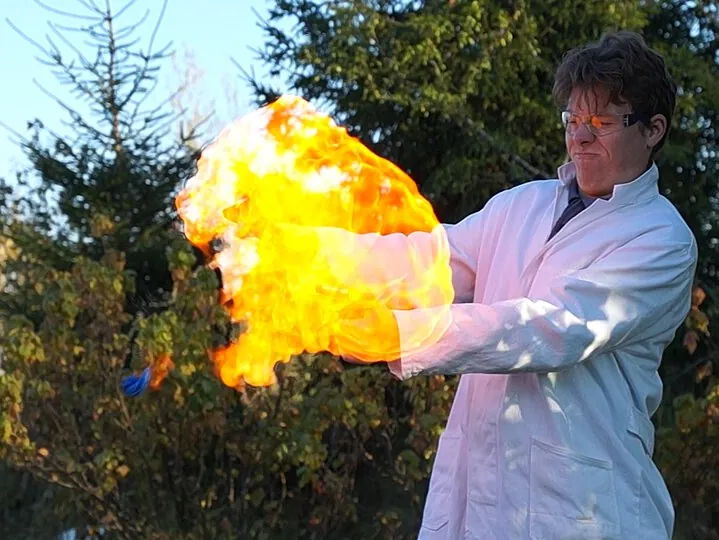
Petrol is exothermic enough to drive a car 700 km on one tank, yet it sits in that tank for months without catching fire. Hydrogen and oxygen can be mixed in a balloon and nothing happens, until a spark turns it into a fireball. Being exothermic is clearly not enough for a reaction to start. There is a hill to climb first.
Activation energy
For particles to react they must collide with enough energy to stretch and break existing bonds, and in the right orientation. The minimum energy a collision needs is the activation energy, $E_a$. At the top of the energy hill, old bonds are partly broken and new ones partly formed: this short-lived, high-energy arrangement is the transition state (or activated complex).
Every reaction has an activation energy, exothermic or endothermic. A spark, a flame or warming a reaction gives enough particles the energy to get over the barrier. In an exothermic reaction, the energy released by the first particles to react then supplies activation energy to their neighbours, so it keeps going on its own. That is why a match lights a whole gas burner.
Energy profile diagrams
An energy profile diagram plots enthalpy against the progress of the reaction. It shows three things at once: the enthalpy of reactants and products (so ΔH), the height of the barrier ($E_a$), and the transition state at the peak.
Rules for drawing one in an exam:
- Label the axes: enthalpy (or energy, with units kJ mol⁻¹) and reaction progress.
- Draw reactants on the left and products on the right at the correct relative heights.
- Draw $E_a$ as an arrow from the reactant level up to the peak, never from the axis.
- Draw ΔH as an arrow from the reactant level to the product level, pointing down for exothermic, up for endothermic.
The reverse reaction travels the same path backwards, so its activation energy is measured from the products to the peak. That gives a useful relationship:
$$\Delta H = E_a(\text{forward}) - E_a(\text{reverse})$$
For the reaction H₂(g) + I₂(g) → 2HI(g), the reactants are at 0 kJ, the transition state at +173 kJ and the products at −9 kJ (per mole of H₂). Find ΔH, $E_a$ and $E_a$(reverse).
- Set reactants to 150 and products to 50. Read off ΔH. Now raise the transition state: which values change and which stay the same?
- Press Next challenge and solve all four. Challenge 3 asks for equal forward and reverse barriers: what does that force ΔH to be?
- Turn on Add a catalyst. By how much do the forward and the reverse Eₐ fall? What happens to ΔH?
- Build an endothermic reaction with ΔH = +100. Can its forward Eₐ ever be smaller than 100 kJ mol⁻¹? Why not?
Catalysts
A catalyst speeds up a reaction without being used up. It does this by providing an alternative reaction pathway with a lower activation energy. On a profile it appears as a lower hump between the same reactant and product levels.
- With a lower barrier, a much larger fraction of collisions have enough energy, so the rate increases (Year 12 Module 5 shows this with the Maxwell–Boltzmann distribution).
- ΔH does not change, because the reactants and products are the same substances. A catalyst cannot make an endothermic reaction exothermic or change how much energy a fuel releases.
- The forward and reverse reactions speed up by the same factor, so a catalyst does not change the position of an equilibrium, only how fast it is reached.
- Many catalysts work by giving the reactants a surface to adsorb onto, which weakens their bonds and holds them in the right orientation. Others form an intermediate compound with a reactant and are regenerated later.
Examples you'll meet: the iron catalyst in the Haber process for ammonia; platinum, palladium and rhodium in car catalytic converters, which turn CO and NO into CO₂ and N₂; vanadium(V) oxide in making sulfuric acid; and enzymes, the protein catalysts that let every reaction in your body happen fast enough at 37 °C.
Test yourself
A reaction has Eₐ(forward) = 85 kJ mol⁻¹ and ΔH = +30 kJ mol⁻¹. What is Eₐ for the reverse reaction?
ΔH = Eₐ(fwd) − Eₐ(rev), so Eₐ(rev) = 85 − 30 = 55 kJ mol⁻¹. The products sit 30 kJ higher, closer to the peak.
Which change would a catalyst make to the energy profile of a reaction?
A catalyst offers a pathway with a lower transition-state energy; reactant and product levels, and so ΔH, are unchanged.
Methane and oxygen can be mixed at room temperature without reacting, although combustion is highly exothermic. The best explanation is that
The activation energy is high, so almost no collisions at 25 °C are energetic enough. A spark provides that energy locally; the heat released then keeps it going.
On a profile, reactants are at 60 kJ, products at 140 kJ and the transition state at 210 kJ. Which is correct?
ΔH = 140 − 60 = +80 kJ; Eₐ = 210 − 60 = 150 kJ.
Label the energy profile.
What does a catalyst change?
The minimum energy needed for a collision to result in reaction is the . The arrangement of atoms at the top of the energy barrier is called the . A catalyst provides an alternative with a activation energy, and it is not in the reaction.
For the decomposition of hydrogen peroxide, 2H₂O₂(aq) → 2H₂O(l) + O₂(g), ΔH = −196 kJ mol⁻¹ and Eₐ = 75 kJ mol⁻¹ without a catalyst. With the enzyme catalase, Eₐ falls to about 8 kJ mol⁻¹.
Construct a labelled energy profile diagram showing the uncatalysed and catalysed reactions, and use it to explain how catalase affects the reaction.
The diagram has enthalpy (kJ mol⁻¹) on the vertical axis and reaction progress on the horizontal. The reactant level (2H₂O₂) is drawn 196 kJ above the product level (2H₂O + O₂), with a downward ΔH arrow of −196 kJ mol⁻¹. The uncatalysed curve rises to a peak 75 kJ above the reactants; the catalysed curve, drawn dashed between the same levels, peaks only about 8 kJ above them. Each Eₐ arrow starts at the reactant level and ends at its peak.
Catalase provides an alternative reaction pathway (the peroxide binds to the enzyme's active site, which weakens the O–O bond). Its activation energy is much lower, so at 37 °C a far greater fraction of collisions have at least the activation energy, and the rate increases enormously. The reactants and products are unchanged, so ΔH is still −196 kJ mol⁻¹, and the enzyme is not consumed.