 Coaching Centre
Intermolecular forces, networks and allotropes
Dispersion forces, dipole–dipole forces and hydrogen bonding, how they explain boiling points, solubility and the unusual properties of water, covalent network solids, allotropes of carbon, oxygen, sulfur and phosphorus, and how to predict the properties of a substance from its structure.
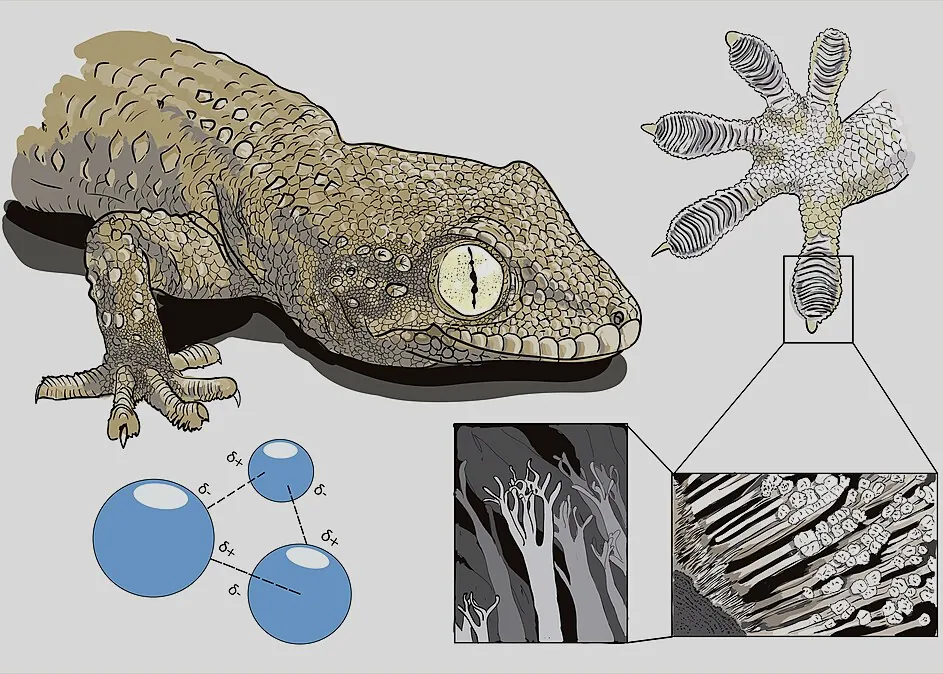
A gecko can run up a pane of glass and hang from the ceiling by one toe, with no glue and no suction. Each toe is covered in about half a million tiny hairs, and each hair splits into hundreds of even finer tips. Those tips get so close to the surface that the weakest attraction in chemistry, the dispersion force between molecules, adds up to enough to hold the animal's weight. The forces between molecules, not the bonds within them, decide whether a substance is a gas, a liquid or a solid, and that is what this lesson is about.
Bonds within molecules, forces between them
Covalent bonds hold the atoms inside a molecule together (intramolecular). Intermolecular forces are the much weaker attractions between molecules. Breaking the H–Cl bond takes 431 kJ mol⁻¹; boiling HCl, which only separates the molecules, takes about 16 kJ mol⁻¹. When a molecular substance melts or boils, the molecules stay intact: only intermolecular forces are overcome. So the melting and boiling points of molecular substances measure the strength of their intermolecular forces.
Dispersion forces
Electrons are always moving. At any instant a molecule's electron cloud may be slightly lopsided, creating a temporary dipole. This induces a dipole in a neighbouring molecule, and the two attract. These dispersion forces act between all molecules, polar or not, and are the only forces between non-polar molecules such as H₂, Cl₂, CH₄ and CO₂.
- More electrons, stronger dispersion forces. A large electron cloud is more easily distorted (more polarisable). Down group 17 the boiling points rise steadily: F₂ −188 °C, Cl₂ −34 °C, Br₂ 59 °C, I₂ 184 °C, which is why at room temperature they run from gas to liquid to solid.
- Larger contact area, stronger dispersion forces. Pentane and 2,2-dimethylpropane are both C₅H₁₂. Long, straight pentane molecules lie alongside each other (bp 36 °C); the compact, nearly spherical isomer touches its neighbours less (bp 10 °C).
Individually weak, dispersion forces can add up: in large molecules they are often the strongest intermolecular force present.
Dipole–dipole forces
Polar molecules have permanent dipoles. They line up so that the δ+ end of one molecule is near the δ− end of the next, giving dipole–dipole forces in addition to dispersion forces. Comparing molecules with the same number of electrons shows the effect: Br₂ (non-polar, 70 electrons) boils at 59 °C, while ICl (polar, 70 electrons) boils at 97 °C.
Hydrogen bonding
When hydrogen is bonded directly to nitrogen, oxygen or fluorine, the bond is very polar and the small hydrogen atom is left almost bare of electrons. It is strongly attracted to a lone pair on an N, O or F atom of a neighbouring molecule. This hydrogen bond is the strongest of the intermolecular forces, about a tenth the strength of a covalent bond, and it only occurs with N–H, O–H or F–H.
H₂S (34 g mol⁻¹) boils at −60 °C. H₂O (18 g mol⁻¹), a smaller molecule with fewer electrons, boils at 100 °C. Explain.
Both are bent and polar, so both have dispersion and dipole–dipole forces. H₂S has more electrons (18 vs 10), so its dispersion forces are stronger.
But water also has O–H bonds and two lone pairs on O, so it forms hydrogen bonds; S is not electronegative enough for H₂S to do so. Each water molecule can form up to four hydrogen bonds.
Much more energy is needed to separate hydrogen-bonded water molecules, so water's boiling point is about 160 °C higher than H₂S, and about 180 °C higher than the −79 °C that the group 16 trend predicts.
Hydrogen bonding explains water's unusual properties, which life depends on:
- Ice floats. In ice each molecule is hydrogen bonded to four others in an open hexagonal lattice, so ice is less dense than liquid water (0.92 vs 1.00 g mL⁻¹). Lakes freeze from the top down, insulating the water below.
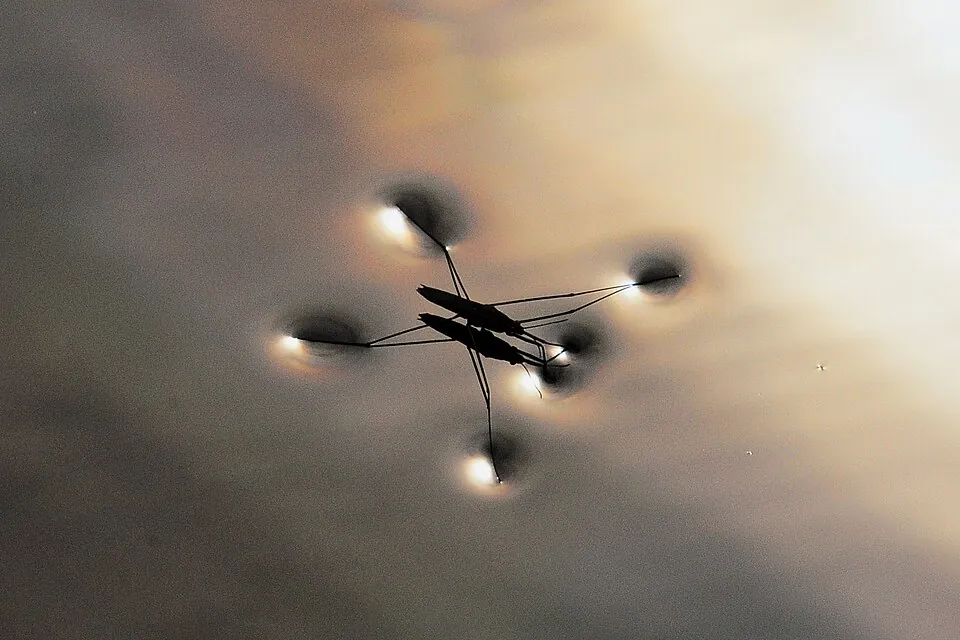
- High surface tension. Molecules at the surface are pulled inwards by hydrogen bonds, making a "skin" strong enough to support a water strider.
- High specific heat capacity and heat of vaporisation. Lots of energy is needed to break hydrogen bonds, so oceans moderate climate and sweating cools you efficiently.
- Biology. Hydrogen bonds hold the two strands of DNA together and fold proteins into working shapes.
- Start on H₂O and turn on Expected without H-bonds. The group 16 trend predicts about −79 °C; water actually boils at 100 °C.
- Read the expected values for HF (−103 °C) and NH₃ (−114 °C). Which of the three has the largest gap, and why?
- Slide to CH₄ and up group 14. Why is there no anomaly at the top of this group?
- Compare HCl (−85 °C) with HI (−35 °C). HCl is the more polar molecule. Which force wins, and why?
Solubility: like dissolves like
A substance dissolves well when the attractions it can form with the solvent are comparable to those it gives up. Polar and ionic substances dissolve in polar solvents such as water: ethanol mixes with water in any proportion because it hydrogen bonds with it. Non-polar substances dissolve in non-polar solvents: iodine dissolves in hexane but barely in water. Oil and water separate because water molecules attract each other far more strongly than they attract oil.
Covalent network solids
Not every covalent substance is made of small molecules. In a covalent network solid, every atom is joined to its neighbours by covalent bonds that extend throughout the whole crystal. There are no separate molecules, so melting means breaking strong covalent bonds.
Carbon dioxide is a covalent molecular substance: strong bonds inside each CO₂ molecule, weak dispersion forces between them, so it sublimes at −78 °C (dry ice). Silicon dioxide (quartz, sand) is a covalent network: each Si is bonded to four O and each O to two Si, so it melts at about 1700 °C. Other network solids include diamond, silicon and silicon carbide (SiC, used in cutting tools). They are typically very hard, have very high melting points, are insoluble in all solvents and do not conduct (graphite is the exception).
Allotropes
Allotropes are different structural forms of the same element in the same physical state. Because their atoms are bonded differently, allotropes can have very different properties.
| Allotrope | Structure | Properties and uses |
|---|---|---|
| Diamond | 3D covalent network; each C bonded to 4 others tetrahedrally | Hardest natural substance; very high melting point; does not conduct (no free electrons); cutting tools, gems |
| Graphite | Flat layers of hexagons; each C bonded to 3 others; one delocalised electron per C; layers held by dispersion forces | Soft and slippery (layers slide); conducts along the layers; very high melting point; pencils, lubricants, electrodes |
| Graphene | A single layer of graphite, one atom thick | Extremely strong for its mass; excellent conductor; nearly transparent; flexible electronics |
| Fullerenes (C₆₀) | Discrete cage molecules of 60 C atoms (12 pentagons, 20 hexagons) | Molecular: soft, sublimes about 600 °C, dissolves in some non-polar solvents; research in medicine and materials |
| Carbon nanotubes | Graphene rolled into a tube about 1 nm wide | Very strong and stiff; metallic or semiconducting; composites and sensors |
Fullerenes were discovered in 1985 by Harold Kroto, Robert Curl and Richard Smalley (Nobel Prize 1996). Graphene was first isolated in 2004 by Andre Geim and Konstantin Novoselov, who peeled layers off graphite with sticky tape (Nobel Prize in Physics 2010).
Other elements show allotropy too:
- Oxygen: dioxygen, O₂, and ozone, O₃. Ozone is a bent, polar molecule (bp −112 °C, compared with −183 °C for O₂), pale blue and toxic to breathe. In the stratosphere it absorbs harmful ultraviolet light.
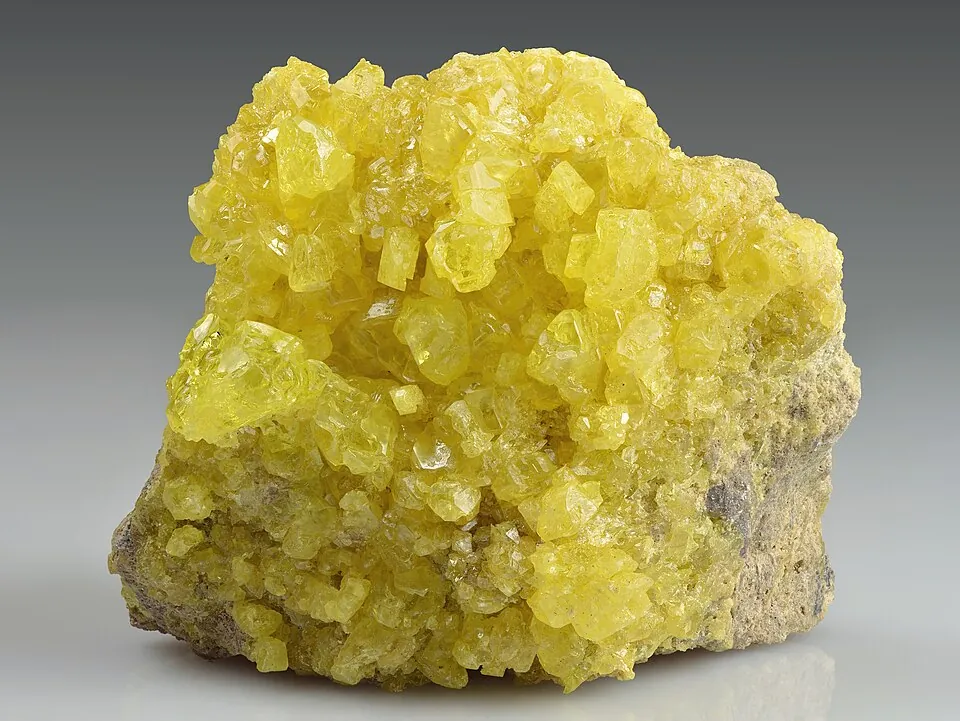
- Sulfur: rhombic sulfur (stable below 95.5 °C) and monoclinic sulfur (95.5 °C up to its melting point of 119 °C) are both made of crown-shaped S₈ rings packed differently. Molten sulfur poured into cold water forms rubbery plastic sulfur, made of long chains.
- Phosphorus: white phosphorus is P₄ tetrahedra with strained 60° bond angles; it is so reactive it ignites in air at about 30 °C and is stored under water. Red phosphorus has the P₄ units linked into chains, so it is much less reactive and is used on the striking strip of matchboxes.
- Spin Diamond and check the readout: inside the crystal each atom has 4 bonds. Then switch to Graphite: 3 bonds. Where does carbon's fourth electron go in graphite?
- Look at Fullerene C₆₀ and count the pentagons around one hexagon. Why does C₆₀ dissolve in some solvents when diamond and graphite do not dissolve in anything?
- Compare Graphene with Nanotube. What has to happen to a graphene sheet to make a tube?
- Open P₄ (white) and estimate the bond angle. Why does a 60° angle make white phosphorus so reactive?
Structure decides properties
| Type | Particles and forces | Melting point | Conductivity | Other properties | Examples |
|---|---|---|---|---|---|
| Ionic | Cations and anions; ionic bonds in a lattice | High | Only molten or dissolved | Hard, brittle; often soluble in water | NaCl, MgO, CaCO₃ |
| Metallic | Cations in a sea of delocalised electrons | Usually high (varies) | Good as solid and liquid | Malleable, ductile, lustrous | Cu, Fe, Na, alloys |
| Covalent molecular | Molecules; strong bonds within, weak intermolecular forces between | Low | No | Soft; often gases or liquids; many dissolve in non-polar solvents | H₂O, CO₂, I₂, sugar |
| Covalent network | Atoms joined by covalent bonds throughout | Very high | No (except graphite) | Very hard; insoluble | Diamond, SiO₂, SiC |
Test yourself
Which substance has hydrogen bonding between its molecules?
Methanol has an O–H bond and lone pairs on O.
Iodine (I₂) is a solid at room temperature, while chlorine (Cl₂) is a gas, because iodine molecules
Both are non-polar; I₂ has 106 electrons against 34 in Cl₂.
A solid melts at 1610 °C, is very hard, does not conduct as a solid or liquid and is insoluble in water. It is most likely
An ionic solid would conduct when molten; the properties fit a network such as SiO₂.
Graphite conducts electricity but diamond does not because
Three bonds per carbon in graphite leave one electron free to move along the layer.
Ice is less dense than liquid water because
The regular hydrogen-bonded lattice of ice holds molecules further apart than in the liquid.
Name each allotrope of carbon.
Which intermolecular forces act between these molecules?
Order these from lowest to highest boiling point.
Attractions between molecules are called forces. The forces caused by temporary dipoles are forces. Hydrogen bonding occurs when hydrogen is bonded to nitrogen, oxygen or . Different structural forms of the same element are called . Each carbon atom in diamond forms covalent bonds.
Use the data to explain the trends and anomalies in boiling point, with reference to structure and intermolecular forces. Boiling points (°C): CH₄ −162, SiH₄ −112, GeH₄ −88; H₂O 100, H₂S −60, H₂Se −41, H₂Te −2.
Group 14: CH₄, SiH₄ and GeH₄ are tetrahedral and non-polar, so only dispersion forces act between molecules. Dispersion forces strengthen as the number of electrons increases (10, 18, 36), because larger electron clouds are more easily polarised. Boiling point therefore rises steadily from −162 to −88 °C.
Group 16 from H₂S to H₂Te: these are bent, polar molecules with dispersion and dipole–dipole forces. Polarity actually falls slightly down the group, but dispersion forces increase strongly with the number of electrons, so boiling point rises from −60 to −2 °C. Each is higher than the group 14 hydride of the same period because of the extra dipole–dipole forces.
Water: following the trend, H₂O would boil at about −80 °C. Instead it boils at 100 °C because it has O–H bonds, and oxygen is small and highly electronegative with two lone pairs. Each molecule can form up to four hydrogen bonds with its neighbours. Hydrogen bonds are much stronger than dispersion or dipole–dipole forces, so much more energy is needed to separate the molecules. CH₄ shows no such anomaly because carbon is not electronegative enough for hydrogen bonding.