 Coaching Centre
Calorimetry and heat of solution
Specific heat capacity, q = mcΔT, molar enthalpy change, the coffee-cup calorimeter, measuring heats of solution, cooling corrections by extrapolation, and analysing errors against secondary-sourced data.
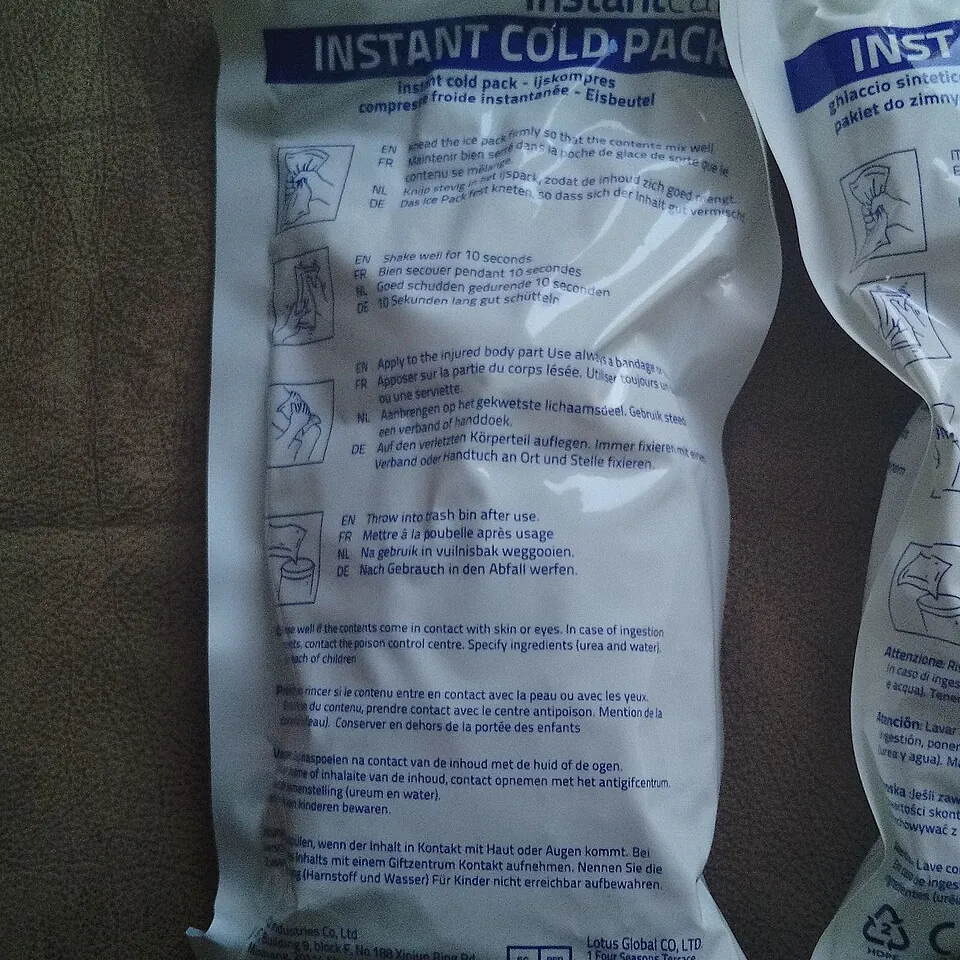
A sports physio's cold pack holds about 40 g of ammonium nitrate and a pouch of water. How cold will it get? You can predict the answer to within a degree with one formula, a data book value and some moles. You can also measure it with two polystyrene cups and a thermometer, and that turns out to be one of the most error-prone experiments in the Year 11 course. This page shows how to do it well.
Specific heat capacity and q = mcΔT
The specific heat capacity, $c$, of a substance is the heat needed to raise the temperature of 1 g of it by 1 K (or 1 °C, which is the same size step). Water's is unusually high:
| Substance | c (J g⁻¹ K⁻¹) |
|---|---|
| Water | 4.18 |
| Ethanol | 2.44 |
| Aluminium | 0.90 |
| Glass | 0.84 |
| Copper | 0.39 |
The heat absorbed or released when a mass $m$ changes temperature by $\Delta T$ is
$$q = mc\Delta T$$
With $m$ in grams and $c$ in J g⁻¹ K⁻¹, $q$ comes out in joules. (The HSC data sheet gives water's value as $4.18 \times 10^3$ J kg⁻¹ K⁻¹; if you use that, $m$ must be in kilograms.) In a dilute solution, assume the solution has the same $c$ as water and a density of 1.00 g mL⁻¹, so 100 mL has a mass of 100 g. The physics of heat capacity is covered in Year 11 Physics Module 3; here we use it to measure chemistry.
From q to molar enthalpy change
$q$ is the heat for the amount you happened to use. To compare with data, scale it to one mole:
$$\Delta H = -\frac{q}{n}$$
The minus sign is there because $q$ is the heat gained by the water (the surroundings). If the water gains heat, the system lost it, so ΔH is negative. Always check the sign at the end: temperature up means ΔH negative.
4.00 g of NaOH is dissolved in 100.0 mL of water in a polystyrene cup. The temperature rises from 21.5 °C to 31.6 °C. Calculate the molar heat of solution of NaOH.
Predict the final temperature when 8.00 g of NH₄NO₃ (ΔsolH = +25.7 kJ mol⁻¹) dissolves in 50.0 g of water at 22.0 °C. Assume no heat exchange with the surroundings.
The coffee-cup calorimeter
A calorimeter is any container designed to trap the heat of a reaction so you can measure it. For reactions in solution, two nested polystyrene cups with a lid are simple and surprisingly good: polystyrene is a poor conductor and has a tiny heat capacity, so almost all the heat goes into the solution.
For more accurate work, the calorimeter's own heat capacity, $C$ (in J K⁻¹), is measured first by releasing a known amount of heat in it, and then included: $q = (mc + C)\Delta T$. For polystyrene cups $C$ is only about 10 to 20 J K⁻¹, compared with about 420 J K⁻¹ for 100 g of water, so it is often ignored. A glass beaker or a metal can is a different story.
Correcting for heat loss: extrapolation
Even in a good calorimeter, the solution starts exchanging heat with the room the moment its temperature changes. By the time the reading peaks, some heat has already gone. The fix is to record the temperature every 30 seconds before and after mixing, plot it, and extend the cooling (or warming) line back to the moment of mixing.
- With the default settings (NaOH, 4.0 g, 100 mL, extrapolation, lid on, probe), the result is within about 3% of −44.5 kJ mol⁻¹. Where do the last few percent go?
- Switch to ΔT from highest/lowest reading, then take the Lid off as well. How big does the error get?
- Turn on Lumpy solid with extrapolation. Why can't extrapolation fix this error?
- Choose NH₄NO₃ with 1.0 g and the Thermometer ±0.5 °C. Why is a small ΔT a problem?
- Compare m = water + solid with m = water only. Which systematic error does the second choice introduce?
Comparing with secondary-sourced data
| Solid | ΔsolH (kJ mol⁻¹) | Effect on water |
|---|---|---|
| CaCl₂ | −81.3 | Warms strongly |
| NaOH | −44.5 | Warms |
| LiCl | −37.0 | Warms |
| NH₄Cl | +14.8 | Cools |
| NH₄NO₃ | +25.7 | Cools |
| KNO₃ | +34.9 | Cools |
Data values are for dilute solutions at 25 °C. Experimental results for exothermic dissolving are almost always smaller in magnitude than these, because nearly every error (heat loss, heat absorbed by the cup, undissolved solid, water absorbed by the solid) makes |ΔT| or n come out wrong in the same direction. An answer that is too big usually means a calculation slip, such as forgetting to convert J to kJ.
Test yourself
2.22 g of CaCl₂ (M = 110.98 g mol⁻¹) dissolves in 50.0 mL of water and the temperature rises by 7.4 °C. What is ΔsolH? (Use the mass of water only.)
q = 50.0 × 4.18 × 7.4 = 1547 J = 1.547 kJ; n = 2.22 ÷ 110.98 = 0.0200 mol; ΔH = −1.547 ÷ 0.0200 = −77 kJ mol⁻¹.
Why does extrapolating a temperature–time graph give a more accurate ΔT than the highest reading?
Heat exchange begins as soon as the temperature changes; extrapolating the cooling line back to the time of mixing removes that loss. It does not fix undissolved solid or the cup's heat capacity.
A student's value for the heat of solution of NaOH is −36 kJ mol⁻¹ (data: −44.5 kJ mol⁻¹). Which error could explain this?
Wet NaOH contains less NaOH than its mass suggests, so the real n is smaller than calculated and |ΔH| comes out too small. Options 1 and 2 would make the result too large; option 4 would make it 1000 times too large.
How much heat raises the temperature of 250 g of water from 18.0 °C to 30.0 °C?
q = 250 × 4.18 × 12.0 = 12 540 J = 12.5 kJ.
Label the calorimeter and the purpose of each part.
Put the steps for measuring a heat of solution in order.
In q = mcΔT, c is the , which for water is 4.18 J g⁻¹ K⁻¹. Two nested polystyrene cups make a good calorimeter because polystyrene is a good . Because of heat loss, experimental values of |ΔH| are usually . Extrapolating the curve corrects for heat lost after mixing.
A student dissolved 5.06 g of potassium nitrate (M = 101.1 g mol⁻¹) in 100.0 mL of water. The temperature fell from 22.4 °C to 18.7 °C (lowest reading).
(a) Calculate the molar heat of solution of KNO₃. (3 marks)
(b) The data book value is +34.9 kJ mol⁻¹. Calculate the percentage difference and evaluate the method, suggesting two specific improvements. (4 marks)
(a) ΔT = 22.4 − 18.7 = 3.7 K. m = 100.0 + 5.06 = 105.06 g, so q = 105.06 × 4.18 × 3.7 = 1625 J = 1.625 kJ absorbed from the water. n(KNO₃) = 5.06 ÷ 101.1 = 0.0500 mol. ΔsolH = +1.625 ÷ 0.0500 = +32.5 kJ mol⁻¹ (positive because the solution cooled).
(b) Percentage difference = (32.5 − 34.9) ÷ 34.9 × 100 = −6.9%. The magnitude is too small. While the solution was colder than the room, heat flowed in from the air and the bench, so the lowest reading was higher than the true lowest temperature and ΔT was underestimated. The 0.1 K precision of a thermometer reading on a ΔT of only 3.7 K is also significant. Improvements: (1) use a lid and two nested cups, record the temperature every 30 s and extrapolate the warming line back to the time of mixing to correct for heat gained; (2) use a larger mass of KNO₃ (about 10 g) and a 0.1 °C probe so that ΔT is larger and its percentage uncertainty smaller. Repeating three times and averaging would improve reliability. The method is valid for the sign and approximate size of ΔH, but its accuracy is limited by heat exchange with the surroundings.