 Coaching Centre
Entropy
The two drivers of change, entropy as the number of ways particles and energy can be arranged, modelling entropy changes, predicting the sign of ΔS from states and moles of gas, standard molar entropies and calculating ΔS°, and how entropy differs from enthalpy.
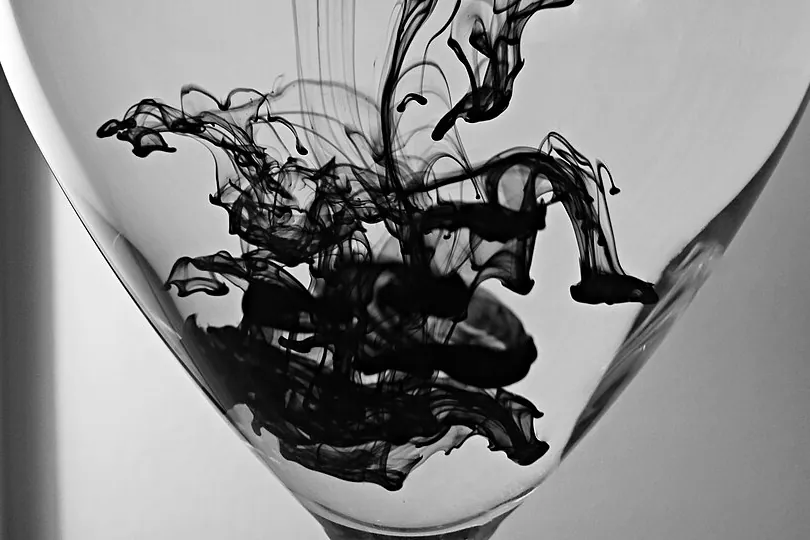
Drop a little food colouring into a glass of still water. Over a few minutes it spreads through the whole glass. Now wait for it to gather itself back into a drop. You'll be waiting longer than the age of the universe. No energy is stopping it; the colour molecules are free to go anywhere. It's just that there are vastly more ways for them to be spread out than to be bunched up. That simple counting argument is the second driver of every chemical reaction.
Two drivers of change
If lower enthalpy were the only thing that mattered, endothermic changes would never happen on their own. But they do, all the time: ice melts on a warm day, a puddle evaporates, ammonium nitrate dissolves in a cold pack, and Ba(OH)₂·8H₂O and NH₄SCN react so endothermically that the flask freezes to a wet board. Each of these turns an ordered arrangement into a more spread-out one: a solid into a liquid, a liquid into a gas, a crystal into ions roaming through a solution, two solids into a solution plus ammonia gas. That spreading out is the second driver, and it's measured by entropy.
What entropy measures
Entropy, $S$, is a measure of how dispersed the particles and the energy of a system are. Older textbooks call it "disorder" or "randomness", which is a fair first picture, but the more precise idea is the number of ways (microstates) the particles and their energy can be arranged while the system looks the same from outside.
With four particles the "all on one side" arrangement still turns up 1 time in 16. With 100 particles it turns up about once in 10³⁰ tries, and with a mole of gas, never. Systems naturally move towards the arrangements with the most ways, which is towards higher entropy.
The same counting applies to energy. Energy is held in packets (quanta) of vibration, rotation and movement. The more quanta there are, and the more places they can go, the more ways there are to share them out. That's why heating anything increases its entropy, and why gas molecules, which can move and rotate freely, have far more ways to hold energy than atoms locked in a crystal.
- With 4 particles, press Remove barrier. How many ways (W) are there for 2 on each side? Watch the dots approach the bars over time.
- Increase to 12 particles. The chance of finding them all on the left is now 1 in 4096. What would it be for 6 × 10²³ particles?
- Switch to Heating a solid with 4 atoms. How does W change as you go from 3 to 6 quanta? What happens to entropy as temperature rises?
- Set the quanta to 0. Why is W = 1 and S = 0? (This is the situation for a perfect crystal at absolute zero.)
Predicting the sign of ΔS
The entropy change of a reaction is $\Delta S = S_\text{products} - S_\text{reactants}$. A positive ΔS means the products are more dispersed. You can usually predict the sign without numbers:
- States: $S(\text{solid}) \lt S(\text{liquid}) \ll S(\text{gas})$. Melting, evaporating, subliming and dissolving a solid usually increase entropy.
- Moles of gas: gases dominate. If the number of moles of gas increases, ΔS is positive; if it decreases, negative.
- Number of particles: splitting one particle into several (decomposition, dissociation into ions) usually increases entropy.
- Temperature: heating a substance increases its entropy.
- Complexity: larger, more complex molecules have more ways to vibrate and rotate, so higher S than smaller ones in the same state.
Predict the sign of ΔS for: (a) 2H₂O₂(l) → 2H₂O(l) + O₂(g); (b) N₂(g) + 3H₂(g) → 2NH₃(g); (c) Ag⁺(aq) + Cl⁻(aq) → AgCl(s).
Standard molar entropies
Unlike enthalpy, entropy has an absolute zero. A perfect crystal at 0 K has only one possible arrangement, so its entropy is zero (the third law of thermodynamics). That means every substance has a definite, positive standard molar entropy, $S^\circ$, the entropy of one mole in its standard state at 298 K. Elements are not zero, unlike ΔfH°.
S° values are in J K⁻¹ mol⁻¹, not kJ. Calculate ΔS° just like ΔH° from formation data:
$$\Delta S^\circ = \sum n\,S^\circ(\text{products}) - \sum n\,S^\circ(\text{reactants})$$
Calculate ΔS° for N₂(g) + 3H₂(g) → 2NH₃(g). S° (J K⁻¹ mol⁻¹): N₂ 191.6, H₂ 130.7, NH₃ 192.5.
Calculate ΔS° for CaCO₃(s) → CaO(s) + CO₂(g). S°: CaCO₃ 92.9, CaO 39.8, CO₂ 213.7.
Entropy and enthalpy compared
| Enthalpy, H | Entropy, S | |
|---|---|---|
| What it measures | Heat content (energy in bonds and attractions) | Dispersal: number of ways to arrange particles and energy |
| Favoured direction | Decrease (ΔH negative) | Increase (ΔS positive) |
| Units | kJ mol⁻¹ | J K⁻¹ mol⁻¹ |
| Absolute values? | No; only changes, with elements set to zero | Yes; S = 0 for a perfect crystal at 0 K |
| Elements in standard state | ΔfH° = 0 | S° greater than 0 |
| Measured by | Calorimetry | Heat capacity measurements from near 0 K |
Test yourself
Which reaction has the largest increase in entropy?
One mole of solid becomes three moles of gas. Option 2 has equal moles of gas; options 1 and 4 decrease entropy.
Using S° (J K⁻¹ mol⁻¹): H₂O(l) 69.9, H₂O(g) 188.8, ΔS° for H₂O(l) → H₂O(g) is
188.8 − 69.9 = +118.9 J K⁻¹ mol⁻¹.
Which statement correctly contrasts entropy and enthalpy?
S = 0 for a perfect crystal at 0 K gives entropy an absolute scale; enthalpy has none, so ΔfH° uses the elements as an arbitrary zero.
Why does a gas have a much higher entropy than the same substance as a solid?
Free to move and rotate through a large volume, gas particles have vastly more possible microstates.
Complete the decision path for predicting ΔS.
Does entropy increase or decrease?
Entropy is a measure of the of particles and energy. Entropy increases from solid to liquid to . Standard molar entropies are measured in J K⁻¹ mol⁻¹, and a perfect crystal at has zero entropy. If the number of moles of gas increases in a reaction, ΔS is .
Consider the reaction 2SO₂(g) + O₂(g) → 2SO₃(g).
(a) Predict the sign of ΔS° and justify your prediction. (2 marks)
(b) Calculate ΔS° using S° (J K⁻¹ mol⁻¹): SO₂ 248.2, O₂ 205.1, SO₃ 256.8, and comment on your prediction. (3 marks)
(a) ΔS° should be negative. Three moles of gas react to form two moles of gas, so there are fewer particles and fewer ways to arrange them and their energy.
(b) Σ products = 2(256.8) = 513.6 J K⁻¹. Σ reactants = 2(248.2) + 205.1 = 701.5 J K⁻¹. ΔS° = 513.6 − 701.5 = −187.9 J K⁻¹ mol⁻¹. The negative value confirms the prediction made from the moles of gas.