 Coaching Centre
The gas laws
Pressure, volume, temperature in kelvin and the kinetic particle theory of gases; Boyle's law, Charles's law and Gay-Lussac's law with graphs, particle explanations and HSC-style calculations; the combined gas law; and investigations of each relationship.
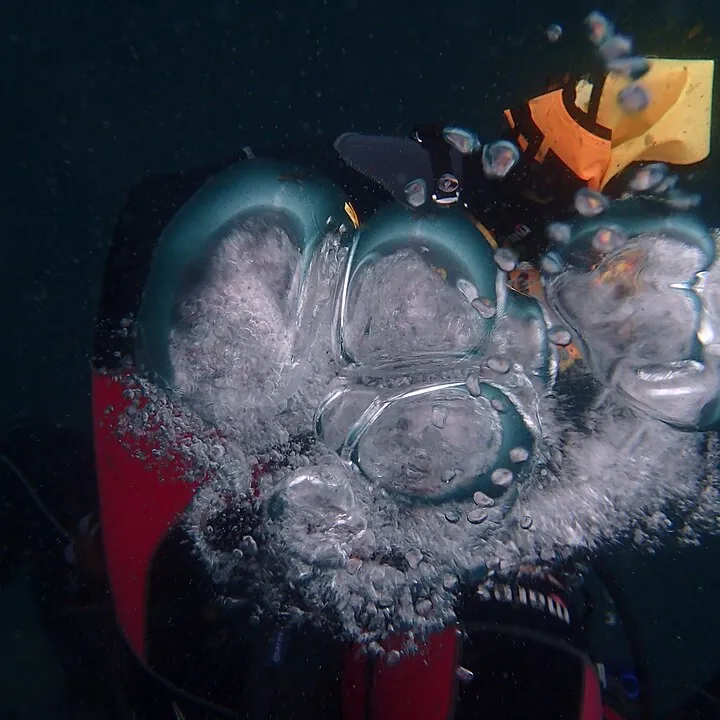
A scuba diver at 30 m breathes air at four times atmospheric pressure. If they hold that breath and swim to the surface, the air in their lungs tries to expand to four times its volume, which can tear lung tissue. Divers are trained never to hold their breath on the way up. The rule behind that training was worked out in the 1660s with a glass tube and some mercury.
Describing a gas
Four quantities describe a sample of gas: pressure P, volume V, temperature T and amount n. The gas laws link them two at a time while the others are held constant.
- Pressure is force per unit area. Gas pressure comes from particles colliding with the walls. The SI unit is the pascal (1 Pa = 1 N m⁻²); chemists use kilopascals. Standard pressure in HSC Chemistry is 100 kPa. You may meet 1 atm = 101.325 kPa = 760 mmHg in older sources.
- Volume of a gas is the volume of its container. 1 L = 1 dm³ = 1000 mL = 1000 cm³; 1 m³ = 1000 L.
- Temperature must be in kelvin in every gas law calculation: T(K) = T(°C) + 273.15. Kelvin starts at absolute zero, the temperature at which particles have the minimum possible kinetic energy, so doubling the kelvin temperature really does double the average kinetic energy.
The kinetic particle theory of gases
The gas laws are explained by a simple model of an ideal gas:
- A gas is made of tiny particles in constant, random, straight-line motion.
- The particles themselves take up a negligible fraction of the volume: a gas is mostly empty space.
- There are no forces of attraction or repulsion between particles except during collisions.
- Collisions with each other and with the walls are perfectly elastic: no kinetic energy is lost overall.
- The average kinetic energy of the particles is proportional to the absolute (kelvin) temperature.
Real gases behave almost ideally at room temperature and ordinary pressures. 2I looks at when and why the model breaks down.
Boyle's law: pressure and volume
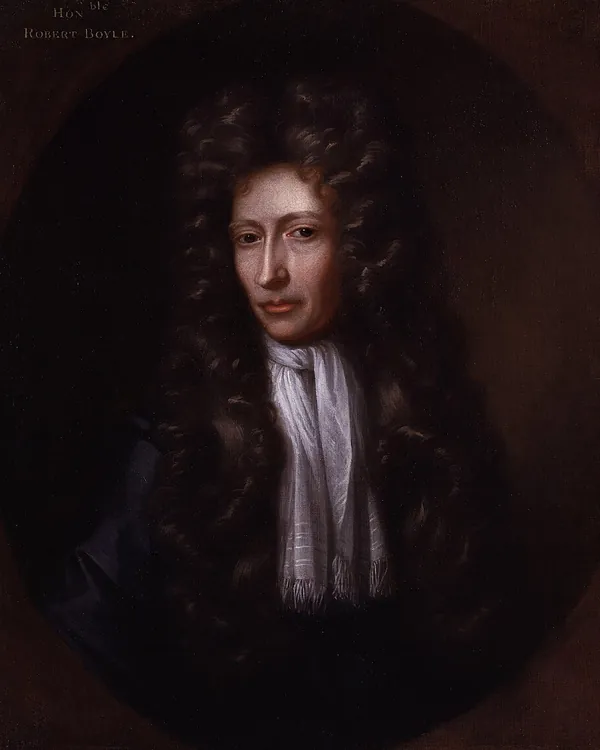
In 1662 Robert Boyle, working with his assistant Robert Hooke, trapped air in a J-shaped tube with mercury and found that squeezing the air into half the volume doubled its pressure. Boyle's law: for a fixed amount of gas at constant temperature, pressure is inversely proportional to volume.
$$P \propto \frac{1}{V} \qquad PV = \text{constant} \qquad P_1V_1 = P_2V_2$$
Particle explanation: halving the volume at constant temperature leaves the particles moving at the same average speed, but they are twice as crowded, so they hit each square centimetre of wall twice as often. Twice the collisions per second means twice the pressure.
2.50 L of air at 100 kPa is compressed at constant temperature to 0.800 L. What is the new pressure?
$P_2 = \dfrac{P_1V_1}{V_2} = \dfrac{100 \times 2.50}{0.800} = 313\ \text{kPa}$
At 30 m depth the total pressure is about 400 kPa. A diver fills a 6.0 L lift bag there and lets it rise to the surface (100 kPa). If no air escaped, what volume would it reach? (Assume constant temperature.)
$V_2 = \dfrac{P_1V_1}{P_2} = \dfrac{400 \times 6.0}{100} = 24\ \text{L}$. Lift bags have release valves for this reason, and lungs have none.
Charles's law: volume and temperature
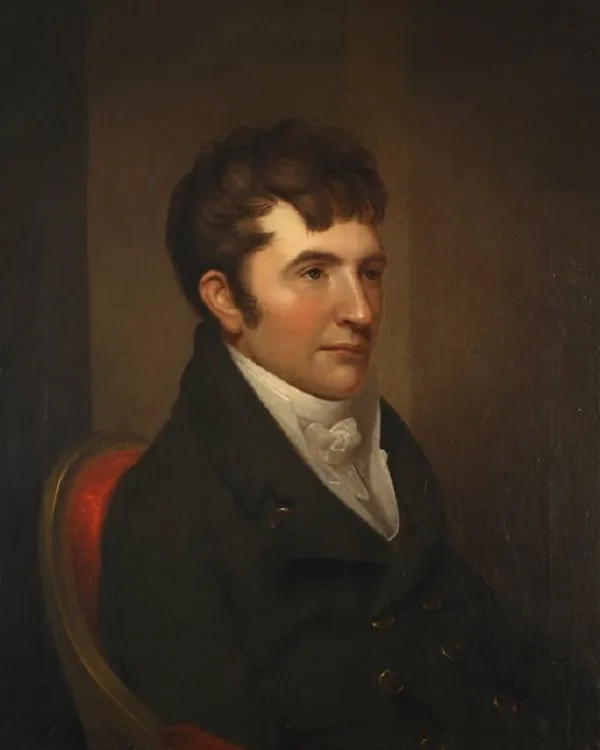
Jacques Charles, a balloonist, noticed in about 1787 that gases expand by the same fraction for each degree of warming. Joseph Gay-Lussac measured and published the relationship in 1802. Charles's law: for a fixed amount of gas at constant pressure, volume is directly proportional to absolute temperature.
$$V \propto T \qquad \frac{V}{T} = \text{constant} \qquad \frac{V_1}{T_1} = \frac{V_2}{T_2}$$
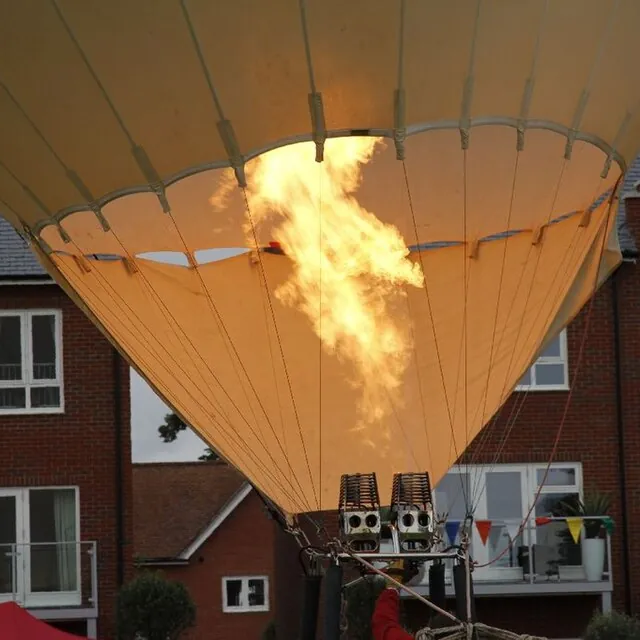
Particle explanation: heating makes the particles move faster, so they hit the walls (and the movable piston or balloon skin) harder and more often. At constant pressure the gas expands until the collisions per unit area fall back to their original rate. That is why a hot-air balloon rises: the warm air inside is spread out more thinly, so the balloon is less dense than the cooler air around it.
A gas occupies 3.00 L at 25 °C. It is heated to 100 °C at constant pressure. Find its new volume.
T₁ = 298.15 K; T₂ = 373.15 K.
$V_2 = V_1 \times \dfrac{T_2}{T_1} = 3.00 \times \dfrac{373.15}{298.15} = 3.75\ \text{L}$. (Using °C would give 12 L, which is obviously wrong: heating from 25 to 100 °C doesn't quadruple the volume.)
Gay-Lussac's law: pressure and temperature
Gay-Lussac's law: for a fixed amount of gas in a fixed volume, pressure is directly proportional to absolute temperature. (Guillaume Amontons had noticed this around 1700, so you may see it called Amontons's law.)
$$P \propto T \qquad \frac{P_1}{T_1} = \frac{P_2}{T_2}$$
Particle explanation: in a rigid container, faster particles collide with the walls both more often and with more force, so the pressure rises. This is why aerosol cans carry the warning "do not expose to temperatures above 50 °C".
A car tyre contains air at an absolute pressure of 320 kPa at 15 °C. After a highway drive the air is at 45 °C. Assuming the volume stays constant, what is the pressure?
$P_2 = P_1 \times \dfrac{T_2}{T_1} = 320 \times \dfrac{318.15}{288.15} = 353\ \text{kPa}$
Tyre gauges read the pressure above atmospheric (about 220 kPa here), which is why tyre pressures should be checked when the tyres are cold.
The combined gas law
For a fixed amount of gas, the three laws combine into one:
$$\frac{P_1V_1}{T_1} = \frac{P_2V_2}{T_2}$$
Any quantity that doesn't change simply cancels, so this one equation covers all three laws. Pressure and volume can be in any units as long as each is the same on both sides; temperature must be in kelvin.
A balloon holds 1.20 L of helium at 100 kPa and 22 °C. It rises to where the pressure is 50.0 kPa and the temperature −20 °C. Find its volume.
$V_2 = V_1 \times \dfrac{P_1}{P_2} \times \dfrac{T_2}{T_1} = 1.20 \times \dfrac{100}{50.0} \times \dfrac{253.15}{295.15} = 2.06\ \text{L}$
The fall in pressure doubles the volume; the cooling shrinks it by about 14%. Real weather balloons launched by the Bureau of Meteorology expand until they burst at 20 to 30 km altitude.
- Boyle: start at 2.479 L (100.0 kPa). Halve the volume to 1.240 L. The pressure should be about 199.9 kPa. Record five or more points, then switch on Plot P against 1/V.
- Charles: raise the temperature from 25 °C to 100 °C. The volume grows to about 3.10 L, not four times as much. Record points from −100 °C to 300 °C: where does the best-fit line meet the temperature axis?
- Gay-Lussac: heat the clamped gas from 25 °C to 100 °C. Check the new pressure (about 125.1 kPa) with P₁/T₁ = P₂/T₂.
- Watch the PV ÷ nT readout as you change things. What does it always equal, and what is that number called? (You'll meet it in 2I.)
Test yourself
A gas at 150 kPa occupies 4.0 L. At constant temperature, what volume does it occupy at 600 kPa?
V₂ = 150 × 4.0 ÷ 600 = 1.0 L.
A balloon has a volume of 2.00 L at 27 °C. At constant pressure, what is its volume at −73 °C?
2.00 × 200.15 ÷ 300.15 = 1.33 L.
Which graph is a straight line through the origin for a fixed amount of gas?
P ∝ T only in kelvin. P against V is a curve; V against °C has an intercept.
According to kinetic particle theory, why does the pressure in a sealed, rigid container rise when it is heated?
Higher average kinetic energy means more frequent and harder collisions per unit area.
A gas at 100 kPa and 20 °C is heated to 313 °C in a fixed volume. What is its new pressure?
T₁ = 293.15 K, T₂ = 586.15 K, so P doubles: 200 kPa.
Which law explains each observation?
Name the gas law each picture explains.
Gas law calculations must use temperature in . At constant temperature, pressure is proportional to volume. Extrapolating a V–T graph gives zero volume at about °C. Gas pressure is caused by particles with the walls of the container.
A sealed 375 mL aerosol can contains gas at 250 kPa and 25 °C. The can will burst at 700 kPa. (a) Calculate the temperature (in °C) at which it bursts. (b) Explain, using kinetic particle theory, why the pressure rises as the can is heated.
(a) Volume and amount are constant, so P₁/T₁ = P₂/T₂. T₁ = 25 + 273.15 = 298.15 K. T₂ = T₁ × P₂ ÷ P₁ = 298.15 × 700 ÷ 250 = 835 K, which is 835 − 273 = 562 °C.
(b) Heating increases the average kinetic energy of the gas particles, so they move faster. Because the can is rigid and sealed, the volume and number of particles stay the same. Faster particles strike the walls more often each second and with more force in each collision, so the total force on each unit area of wall, the pressure, increases.