 Coaching Centre
Molarity, standard solutions and dilution
Calculating molarity with c = n/V, concentrations of individual ions, volumetric glassware and its precision, preparing a standard solution, diluting with c1V1 = c2V2, serial dilution and mixing solutions, with the standard solution and dilution investigation.
Hospital pharmacists dilute concentrated drugs into infusion bags every day, and a slip of one decimal place can be fatal. That is why chemists use glassware calibrated to a few hundredths of a millilitre and a simple, almost foolproof rule: adding water changes the volume, never the number of moles of solute.
Molarity: c = n/V
The molar concentration (molarity) of a solution is the amount of solute in moles per litre of solution:
$$c = \frac{n}{V} \qquad n = cV \qquad V = \frac{n}{c}$$
with c in mol L⁻¹, n in mol and V in litres. Square brackets mean "concentration in mol L⁻¹": [Na⁺] = 0.20 mol L⁻¹.
4.00 g of sodium hydroxide is dissolved in water and made up to 250.0 mL. Calculate the concentration.
n = 4.00 ÷ 40.00 = 0.100 mol; V = 250.0 mL = 0.2500 L.
$c = \dfrac{0.100}{0.2500} = 0.400\ \text{mol L}^{-1}$
What mass of potassium chloride is needed to make 500.0 mL of 0.150 mol L⁻¹ KCl?
n = cV = 0.150 × 0.5000 = 0.0750 mol.
m = nM = 0.0750 × 74.55 = 5.59 g.
Concentrations of ions
Ionic compounds dissociate completely in solution, so multiply by the number of each ion in the formula. In 0.10 mol L⁻¹ Al₂(SO₄)₃: Al₂(SO₄)₃(s) → 2Al³⁺(aq) + 3SO₄²⁻(aq), so [Al³⁺] = 0.20 mol L⁻¹ and [SO₄²⁻] = 0.30 mol L⁻¹.
Standard solutions and volumetric glassware
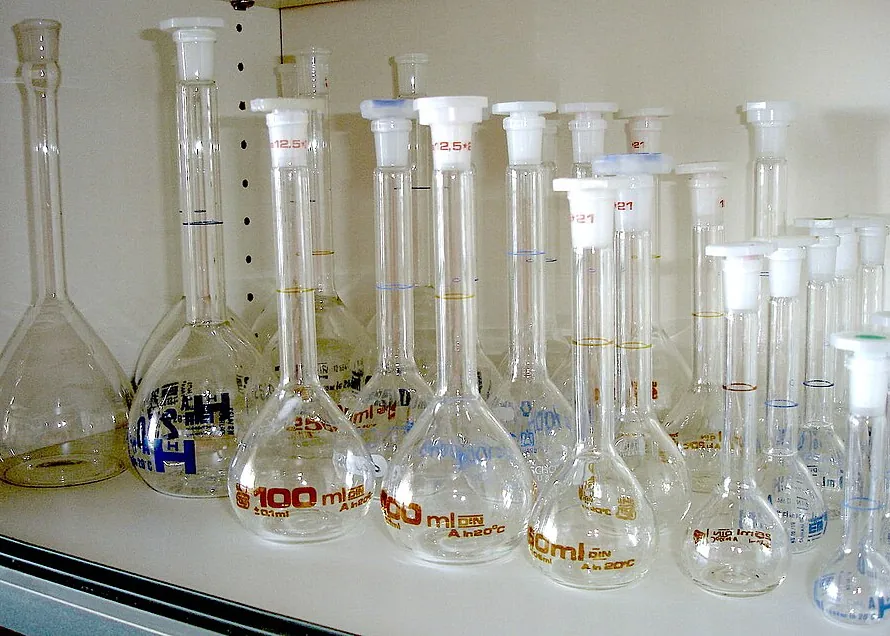
A standard solution is one whose concentration is known accurately. It is made by dissolving an accurately weighed mass of solute and making it up to an accurately known volume in a volumetric flask. The best solutes for this, primary standards, are very pure, stable in air (they don't absorb water or CO₂ or lose water of crystallisation), soluble and have a high molar mass so that weighing errors are small. Anhydrous sodium carbonate is the classic example; you'll use it for titrations in Year 12 (Module 6). Substances such as NaOH, which absorbs water and carbon dioxide from the air, cannot be weighed accurately and must instead be standardised by titration.
| Glassware | Typical tolerance (class A) | Use |
|---|---|---|
| 250 mL volumetric flask | ± 0.15 mL | making up standard solutions and dilutions |
| 25 mL bulb pipette | ± 0.03 mL | transferring an exact volume |
| 50 mL burette | ± 0.05 mL | delivering a measured, variable volume |
| 100 mL measuring cylinder | ± 0.5 to 1 mL | approximate volumes only |
| beaker | about ± 5% | never for measuring |
Read every volume at eye level, with the bottom of the meniscus on the line. Record volumes to the precision of the glassware: a 250 mL volumetric flask is 250.0 mL and a pipette 25.00 mL.
Dilution: c₁V₁ = c₂V₂
When water is added to a solution, the moles of solute stay the same and only the volume increases. Moles before = moles after, and since n = cV:
$$c_1V_1 = c_2V_2$$
V₁ and V₂ can be in any unit as long as both are the same (mL is usually easiest). V₂ is the final total volume, not the volume of water added.
25.00 mL of 2.00 mol L⁻¹ HCl is transferred by pipette into a 250.0 mL volumetric flask and made up to the mark. What is the new concentration?
$c_2 = \dfrac{c_1V_1}{V_2} = \dfrac{2.00 \times 25.00}{250.0} = 0.200\ \text{mol L}^{-1}$
Concentrated sulfuric acid is 18.0 mol L⁻¹. What volume is needed to make 500.0 mL of 0.500 mol L⁻¹ H₂SO₄?
$V_1 = \dfrac{c_2V_2}{c_1} = \dfrac{0.500 \times 500.0}{18.0} = 13.9\ \text{mL}$
Safety: add the acid slowly to about 300 mL of water in the flask, swirl and cool, then make up to the mark. Never add water to concentrated acid: the heat released can make it boil and spit.
100.0 mL of 0.200 mol L⁻¹ NaCl is mixed with 50.0 mL of 0.500 mol L⁻¹ NaCl. What is the final concentration?
n = 0.200 × 0.1000 + 0.500 × 0.0500 = 0.0200 + 0.0250 = 0.0450 mol.
V = 0.1500 L, so c = 0.0450 ÷ 0.1500 = 0.300 mol L⁻¹. (c₁V₁ = c₂V₂ alone doesn't work here: add the moles.)
Serial dilution repeats the same dilution several times, for example 10.00 mL made up to 100.0 mL at each step. Each step divides the concentration by 10, so a 0.100 mol L⁻¹ stock becomes 10⁻², 10⁻³ and 10⁻⁴ mol L⁻¹. It is the accurate way to make very dilute standards, such as those for colorimetry, without weighing impossibly small masses.
- Work out the mass of CuSO₄·5H₂O (M = 249.7 g mol⁻¹) for 250.0 mL of 0.1000 mol L⁻¹ solution. Set it (6.24 g) and press Make up to 250.0 mL.
- Turn on Forget to rinse the beaker and make it again. The label still says 0.1000, but the solution is 0.0970 mol L⁻¹: 3% low. Try Fill above the mark too.
- Does Flask still wet with water cause an error? Why not?
- Switch to 2. Dilute it. With a 25.00 mL pipette and a 250.0 mL flask the concentration falls to about 0.0100 mol L⁻¹. Which combination gives the biggest dilution factor?
- Press Serial dilution four times. What is the concentration in flask 4?
Test yourself
What is the concentration of a solution made by dissolving 0.250 mol of glucose in water to make 500.0 mL of solution?
0.250 ÷ 0.5000 = 0.500 mol L⁻¹.
What is the concentration of chloride ions in 0.15 mol L⁻¹ magnesium chloride solution?
MgCl₂ → Mg²⁺ + 2Cl⁻.
Water is added to 40.0 mL of 0.600 mol L⁻¹ KOH until the volume is 300.0 mL. What is the new concentration?
0.600 × 40.0 ÷ 300.0 = 0.0800 mol L⁻¹.
Which practice causes the concentration of a standard solution to be lower than calculated?
Overfilling increases the volume. A wet flask is fine; a balance reading low means more solute than recorded, making it more concentrated.
Why is sodium hydroxide unsuitable as a primary standard?
A primary standard must be stable in air so its weighed mass is all solute.
Label the volumetric glassware.
Put the steps for making a standard solution in order.
Molarity is moles of solute divided by the volume of solution in . A solution of accurately known concentration is a solution. On dilution, the number of of solute stays the same. A pipette should be rinsed with the it will deliver.
A student must prepare 100.0 mL of 0.0200 mol L⁻¹ potassium permanganate solution, starting from solid KMnO₄ (M = 158.04 g mol⁻¹). The balance reads to ±0.01 g. (a) Show why weighing the solid directly into a 100.0 mL flask is not accurate enough. (b) Describe a better method using a 250.0 mL volumetric flask and dilution, including the calculations.
(a) n = 0.0200 × 0.1000 = 2.00 × 10⁻³ mol; m = 2.00 × 10⁻³ × 158.04 = 0.316 g. An uncertainty of ±0.01 g in 0.316 g is ±3.2%, which is too large for a standard solution.
(b) Make a stock that is ten times more concentrated in a larger volume. For 250.0 mL of 0.2000 mol L⁻¹: n = 0.05000 mol, m = 7.90 g. The weighing uncertainty is now 0.01 ÷ 7.90 = 0.13%. Dissolve the solid in about 150 mL of distilled water in a beaker, transfer through a funnel into the 250.0 mL volumetric flask, rinse the beaker and funnel three times into the flask, make up so the meniscus sits on the mark and invert to mix. Rinse a 10.00 mL pipette with the stock, pipette 10.00 mL into a 100.0 mL volumetric flask and make up to the mark with distilled water. c₂ = c₁V₁ ÷ V₂ = 0.2000 × 10.00 ÷ 100.0 = 0.0200 mol L⁻¹.