 Coaching Centre
Reactivity of metals and the activity series
Comparing how metals react with water, steam, dilute acid, oxygen and other metal ions, building the activity series from experimental data, single displacement reactions, and relating reactivity to first ionisation energy and its limits.
Gold pulled out of a Victorian creek in the 1850s was still bright yellow after millions of years in water and gravel. A lump of sodium the same size would last about a minute in that creek. The difference comes down to how easily each metal gives away its outer electrons, and once you can rank metals by that, you can predict which reactions will happen before you try them.
Metals with water and steam
When a metal reacts with water, it gives its electrons to water molecules, forming a metal hydroxide (or oxide, with steam) and hydrogen gas.
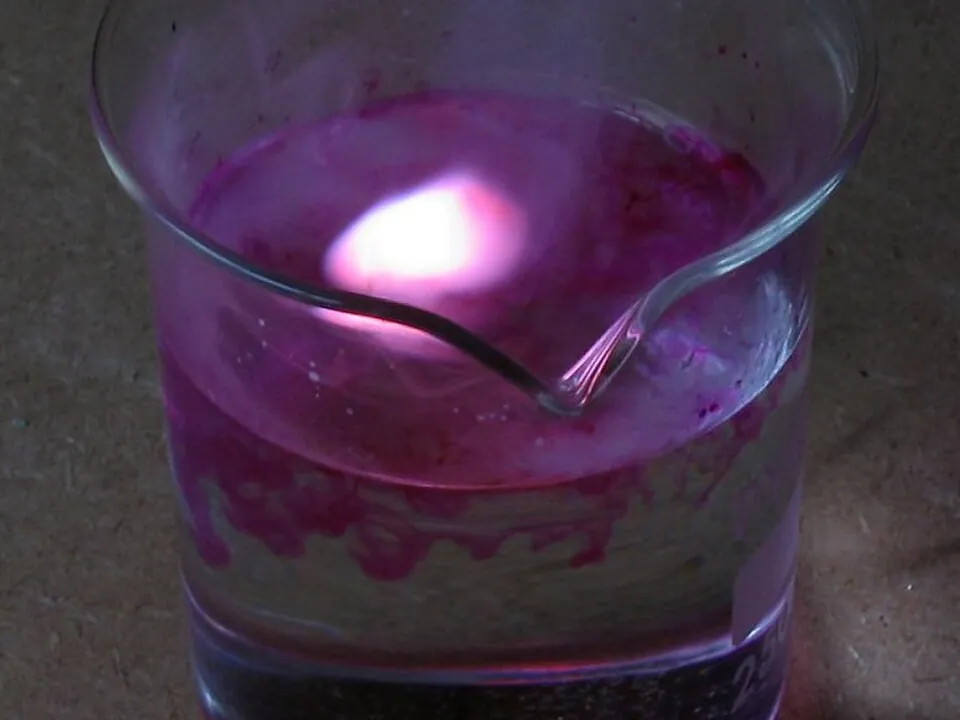
- Group 1 metals react with cold water, faster down the group: 2Na(s) + 2H₂O(l) → 2NaOH(aq) + H₂(g). The solution becomes alkaline.
- Calcium reacts steadily with cold water: Ca(s) + 2H₂O(l) → Ca(OH)₂(aq) + H₂(g). Calcium hydroxide is only slightly soluble, so the water goes cloudy.
- Magnesium reacts very slowly with cold water but burns in steam: Mg(s) + H₂O(g) → MgO(s) + H₂(g).
- Zinc and iron react only with steam, and slowly: 3Fe(s) + 4H₂O(g) → Fe₃O₄(s) + 4H₂(g).
- Lead, copper, silver and gold don't react with water or steam.
Metals with dilute acid
Metals above hydrogen in the activity series react with dilute hydrochloric or sulfuric acid to form a salt and hydrogen. This is a single displacement: the metal pushes hydrogen out of the acid.
$$\text{Zn(s)} + 2\text{HCl(aq)} \rightarrow \text{ZnCl}_2\text{(aq)} + \text{H}_2\text{(g)}$$
The chloride ions are spectators, so the net ionic equation is Zn(s) + 2H⁺(aq) → Zn²⁺(aq) + H₂(g). The rate of bubbling is a good way to compare metals: magnesium fizzes rapidly, zinc steadily, iron slowly (giving a pale green Fe²⁺ solution), lead hardly at all, and copper not at all. Lead is a special case: it sits just above hydrogen, but insoluble PbCl₂ or PbSO₄ coats the metal and stops the reaction.
Two warnings. Group 1 metals and calcium react violently with acids, so these are never done in a school lab. And aluminium often seems unreactive at first because it is covered by a tough, thin layer of Al₂O₃. Once the acid dissolves the layer, the metal fizzes steadily.
Metals with oxygen
Most metals react with oxygen to form oxides, which is a synthesis (and, if the metal burns, combustion): 2Mg(s) + O₂(g) → 2MgO(s). Very reactive metals tarnish within seconds of being cut and are stored under oil. Magnesium burns with a dazzling white flame, iron wool burns with sparks, and copper only forms a black coating of CuO when heated. Silver and gold don't react with oxygen even when strongly heated, which is why gold is found as the native metal.
Building the activity series
Put the results together and the metals fall into the same order every time. This order is the activity series:
K > Na > Li > Ca > Mg > Al > Zn > Fe > Sn > Pb > (H) > Cu > Ag > Au
| Metal | Cold water | Steam | Dilute acid | Heated in air |
|---|---|---|---|---|
| K, Na, Li | fast to violent | dangerous | explosive | burn readily |
| Ca | steady | vigorous | very vigorous | burns |
| Mg | very slow | burns | rapid | burns brightly |
| Al, Zn, Fe | none | slow when hot | moderate to slow | oxide forms; powders burn |
| Sn, Pb | none | none | very slow | oxide forms slowly |
| Cu | none | none | none | black oxide coating |
| Ag, Au | none | none | none | none |
The series also predicts displacement reactions with metal ions. A metal will displace a less reactive metal from a solution of its ions, but not a more reactive one.
Predict whether a reaction occurs when (a) iron nails are placed in copper(II) sulfate solution and (b) copper wire is placed in zinc sulfate solution. Write net ionic equations where a reaction occurs.
(a) Iron is above copper, so iron displaces copper. The nail becomes coated with pink-brown copper and the blue colour fades: $$\text{Fe(s)} + \text{Cu}^{2+}\text{(aq)} \rightarrow \text{Fe}^{2+}\text{(aq)} + \text{Cu(s)}$$
(b) Copper is below zinc, so there is no reaction. Copper pipes can safely carry zinc-containing water; a zinc-coated (galvanised) tank, however, will be attacked by copper ions.
Reactivity and first ionisation energy
When a metal reacts, it loses its valence electrons to become a positive ion. The first ionisation energy is the energy needed to remove one mole of electrons from one mole of gaseous atoms:
$$\text{M(g)} \rightarrow \text{M}^+\text{(g)} + \text{e}^- \qquad \Delta H = \text{first ionisation energy}$$
It makes sense that metals with low ionisation energies are the most reactive, and broadly they are. Down group 1 the outer electron is further from the nucleus and better shielded, so the ionisation energy falls (Li 520, Na 496, K 419 kJ mol⁻¹) and reactivity with water increases. Across period 3, Na (496) is more reactive than Mg (738).
Look closely, though, and the correlation is far from perfect:
- Lithium has a higher ionisation energy than sodium, yet it is the strongest reducing agent of all metals in water (lesson 3E). In the lab it reacts more slowly than sodium because it doesn't melt, but the energy released is large because the tiny Li⁺ ion is very strongly hydrated.
- Calcium and magnesium must lose two electrons and aluminium three, so the first ionisation energy alone tells only part of the story.
- Lead and silver have lower first ionisation energies than iron and copper, yet they are less reactive.
The first ionisation energy is a property of isolated gaseous atoms. A real reaction also involves breaking up the solid metal (atomisation) and the energy released when the ions are hydrated or form a lattice. The overall balance of all these steps sets the reactivity. So the right conclusion for an exam is: first ionisation energy is a useful guide to reactivity, especially within a group, but it isn't the only factor.
- Select Mg and run all four tests. It is very slow in cold water but fizzes rapidly in dilute HCl. Write the net ionic equation shown for the acid test.
- Compare Na, Li and K in cold water. The ionisation energies read 496, 520 and 419 kJ mol⁻¹. Does the order of reactivity match?
- Select Al in cold water and then in dilute HCl. Why is the acid reaction "slow to start"?
- Select Pb (716 kJ mol⁻¹) and Cu (745 kJ mol⁻¹) in dilute HCl. Lead reacts barely and copper not at all. Then compare Ag at 731 kJ mol⁻¹. What does this say about using ionisation energy alone?
Test yourself
Which metal would react with dilute hydrochloric acid but not with cold water?
Zinc is above hydrogen but below magnesium in the series.
A strip of metal X is placed in solutions of Pb(NO₃)₂, Fe(NO₃)₂ and Mg(NO₃)₂. A coating forms only in the lead nitrate solution. Where does X fit in the activity series?
X displaces lead but not iron or magnesium, so it is below Fe and above Pb (tin is an example).
Which equation correctly represents aluminium displacing copper from copper(II) sulfate solution?
Charge: 3(+2) = +6 on the left and 2(+3) = +6 on the right.
Down group 1 the reactivity of the metals increases. The best explanation is that
Nuclear charge increases down the group, but the extra distance and shielding win.
Which observation shows that the first ionisation energy does not fully explain metal reactivity?
Lead has the lower ionisation energy but is the less reactive metal; the others fit the trend.
Arrange these metals from most reactive to least reactive.
Metals above in the activity series react with dilute acids to produce a salt and hydrogen gas. Magnesium reacts with steam to form magnesium and hydrogen. Aluminium seems less reactive than expected because of a protective . Down a group, first ionisation energy and reactivity increases. A metal will a less reactive metal from a solution of its ions.
A student claims: "The lower a metal's first ionisation energy, the more reactive it is." Evaluate this claim using data for at least four metals.
The claim is a useful guide but is not fully valid.
It works well within a group. Down group 1 the first ionisation energy falls (Li 520, Na 496, K 419 kJ mol⁻¹) because the outer electron is further from the nucleus and more shielded, and reactivity with water increases in the same order (Li < Na < K). Across a period it also works: sodium (496) is far more reactive than magnesium (738).
However, there are clear exceptions. Lead (716) and silver (731) have lower first ionisation energies than iron (762) and copper (745), yet lead is less reactive than iron and silver is less reactive than copper. Aluminium (578) has a lower value than magnesium (738) but is below it in the activity series.
The reason is that first ionisation energy describes removing one electron from an isolated gaseous atom. In a real reaction the solid metal must first be atomised, many metals lose two or three electrons, and energy is released when the ions are hydrated or form a lattice. Reactivity depends on the balance of all these energy changes. So the claim should be limited to: within a group, lower first ionisation energy generally means higher reactivity.